|
Good afternoon. Hopefully you enjoyed a day off work to celebrate Veteran’s Day. But did you realize China had a holiday of its own yesterday?
Contrived to celebrate people who aren’t in relationships, Singles’ Day has morphed into China’s biggest online shopping day of the year and become a key barometer of consumer sentiment in the world’s second-largest economy. But with that economy wallowing in a multi-year downturn, analysts predict this will be one of the worst Singles’ Days since the tradition began in 2009.
Looks like those lonely hearts won’t even get to fill the hole in their hearts with mindless retail therapy this year. Don’t worry, singles: Black Friday is only a few weeks away.
—Mark Reeth & Lucy Brewster
|
|
|
|
|
|
|
|
|
|
|
|
|
|
|
|
| Data is provided by |

|
*Stock data as of market close, cryptocurrency data as of 4:00pm ET.
Here's what these numbers mean.
|
- The S&P 500 hit its 50th record high of the year yesterday, but today investors decided they needed a breather from the recent rally. All three indexes bounced a bit in the afternoon, but all three spent the day almost entirely in the red.
-
Gold and oil did their best to stop their recent selloffs, but oil failed to recover from OPEC’s bad news, and gold couldn’t stem the losses as the dollar continues to gain strength.
-
Bitcoin spent the day hovering near its record high of $89,742, though traders are betting big that it’ll hit $90,000 any minute now.
|
|
|
|
Emily Parsons
|
That 6’5” blue-eyed man in finance can splash out on one more week at his Aspen vacation rental this winter.
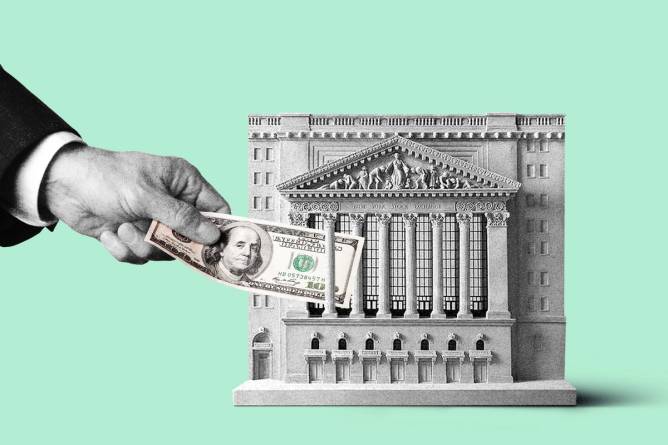
Wall Street bonuses, notorious for turning bankers’ already lofty annual salaries into gargantuan prizes, are projected to increase for the first time since 2021—growing as much as 35% for some lucky, overworked, Sweetgreen-inhaling bankers.
So, who earned the big bucks?
Debt underwriters, or investment bankers who help companies sell their debt, will kick back and watch their bonuses jump as much as 25% to 35%—the highest of any Wall Street workers. Bonuses for equity underwriters could increase 15% to 25%, while bonuses for equity sales and trading desks could rise 15% to 20%, according to a report from compensation consulting firm Johnson Associates Inc.
But not every business is going to enjoy as much of a boost. Bonuses for retail and commercial banking will stay flat, or even decrease, while real estate bonuses are expected to plateau.
A pretty good year
At the end of the slower summer season, Wall Street firms begin the process of deciding how much they should reward their star performers. While the area of the business’s success plays a huge factor, banks also maneuver bonuses strategically to retain top talent—or in some cases, subtly let others know they’re not as valuable.
Over the past three years, bonuses slid lower as high interest rates and volatility hurt financial firms’ margins.
But 2024 has been a great year for the financial services industry. The S&P 500 hit record high after record high, dealmaking ticked up, the private credit market expanded, and bond issuance skyrocketed.
The big picture: While the current bonus expectations are based on the past three quarters, according to Johnson Associates, Wall Street is optimistic about the years ahead. Analysts expect the Trump administration to loosen the leash on corporate mergers and acquisitions, which should lead to more dealmaking for investment bankers—and bigger bonuses for sealing lucrative deals.—LB
|
|
Sponsored by Miami Stock Exchange
|
|
Need a refresher on electronic exchanges? They’re trading platforms where the complicated ins and outs of buying and selling are automated by advanced tech—easy enough.
But here’s some big news: MIAX is upping the electronic exchange game.
MIAX Sapphire, their fourth US options exchange, follows a taker-maker model and features a state-of-the-art trading floor (coming in 2025) that enhances liquidity and promotes improved price discovery.
MIAX is the real deal. Their four fully automated electronic options exchanges in the US have distinct allocations and pricing models designed to meet specific client demands.
Get the scoop on the future of trading.
|
|
-
Activist investor Elliott Investment Management is at it again, this time with a $5 billion stake in industrial conglomerate Honeywell. Shares gained 3.87% on the news.
-
Shopify announced its ninth consecutive quarter of beating analyst revenue expectations, pushing shares up 21.04%.
-
Bad news is good news: 40% of the workforce at 23andMe is getting laid off to cut costs. Shareholders cheered, and shares climbed 2.17%.
-
Where’s the beef? Tyson Foods popped 6.55% after announcing strong earnings thanks to higher beef and chicken prices last quarter.
-
Sentinel One climbed 2.01% after Deutsche Bank analysts upgraded the cybersecurity stock from “hold” to “buy,” noting it should profit from CrowdStrike’s outage earlier this year.
 What’s down What’s down
|
|
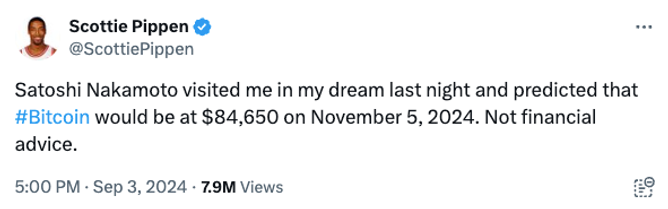
Scottie Pippen via X
|
Here’s a question we never thought we’d ask: Is Scottie Pippen really bitcoin creator Satoshi Nakamoto in disguise?
The tweet above from the Chicago Bulls legend has been making its way around financial circles lately as crypto fans take a victory lap. For those living under a rock, bitcoin soared to a new all-time high just shy of $90,000 this week thanks to a second Trump presidency and hopes of a lenient regulatory environment.
While Scottie’s exact price and timing were a bit off, it’s still an impressive forecast of bitcoin’s success—success that many haters never thought would come to pass. But not the prediction market: Polymarket bettors now believe there’s a 57% chance that bitcoin will reach $100,000 before the end of the year.
Considering these are the same bettors who called Trump’s victory when traditional polls said otherwise, who are we to wager against both them AND a 6-time NBA champion?
|
|
Timothy A. Clary/Getty Images
|
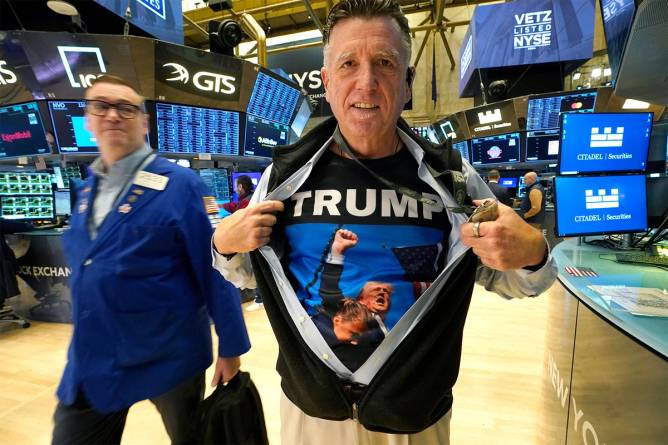
The re-election of Donald Trump has unleashed a wave of investor enthusiasm across the stock market. The logic is straightforward: Trump promises to lower taxes, limit regulation, and support fledgling tech industries like cryptocurrency, all of which equals economic growth.
But with indexes climbing to such lofty heights on the heels of Trump’s victory, investors have to wonder if it’s time to get fearful while others are being oh-so-greedy.
“Over the past several months, the price change of the S&P 500 has distanced itself from the fundamentals,” warned Morgan Stanley Chief Market Strategist Mike Wilson in a recent note.
He isn’t the only one concerned. “The market has to recalibrate because there's been a lot of concerns that valuations have gotten out of whack,” added Laffer Tengler Investments CEO Nancy Tengler.
Other investors argue that Trump 2.0 policies pose economic risks that investors are currently underestimating—such as the repercussions of mass deportations and inflation triggered by aggressive tariffs.
However, most analysts are optimistic about the current rally’s staying power.
“The markets are already well into pricing a ‘Trump trade’ that began in September, but the year-end rally has more room to run,” explained Head of Asset Allocation Americas at UBS Global Wealth Management Jason Draho. “This is consistent with our message that there’s more to go in stocks—our December 2025 price target for the S&P 500 is 6600—but the election outcome has likely pulled forward the timing of some of those returns.”
Where should you invest?
Even if the market-wide rally continues, investors should still be discerning about investing in sectors that should enjoy a boost from actual policies once Trump is in office. For instance, Wilson warned that the small-cap rally could be at risk of slowing due to the sector’s interest rate sensitivity.
“So, we believe longer-term investors are better advised to take advantage of potential tech volatility in the near term to build up sufficient AI exposure,” wrote UBS CIO Americas Solita Marcelli in a note today. “In addition to tech, we like the utilities and financials sectors. Globally, we also favor Asia ex-Japan equities, and see value in Eurozone small and mid-caps.”—LB
|
|
Sponsored by Miami Stock Exchange
|
|
-
The bitcoin hype is very real: It took less than a year for BlackRock’s bitcoin ETF to accrue more assets than BlackRock’s 20-year-old gold ETF.
-
28% of Americans who took on credit card debt during the holiday shopping season last year are still paying off their balance.
-
Take a shot at the king, you best not miss: Activist investor ValueAct has taken a $1 billion position in Meta Platforms.
-
Underbanked households, or those that have a bank account but more frequently use nontraditional financial services like payday loans, are more likely to own cryptocurrencies.
-
Stocks love Trump. Bonds, not so much.
-
The winners and losers of a second Trump presidency.
|
|
|
Tomorrow’s big data drop is the Consumer Price Index, better known by its cool nickname: CPI.
Economists expect consumer prices rose by just 0.2% in October, pegging the annual inflation rate at 2.6%, up from 2.4% in September. All things considered, that’s pretty steady—though Wall Street may become more sensitive to even a slight increase in inflation, given that the president-elect’s proposed policies like tariffs are expected to increase the risk of reigniting inflation in the coming months.
We’ve also got a full slate of Fed Speak, with the presidents of the New York, Dallas, St. Louis, and Kansas City Federal Reserves all lined up to chat about the latest interest rate cut—and their plans for more ahead.
 Before the open Before the open
-
Dole (DOLE) has been doling out profits all year. The fruit and veggie distributor has an impressive bottom line for a company that is exposed to the whims of bad weather hurting harvests, though its revenue is expected to decline this quarter. However, that drop is due to the recent sale of a portion of its fresh fruit business, a move that management believes will strengthen the company’s bottom line in the long run. Investors should like what they hear this quarter, but will want to learn more about the international company’s plans for higher US tariffs. Consensus: $0.21 EPS, $2 billion in revenue.
 After the close After the close
-
Cisco (CSCO) seems like a surefire way to capitalize on the AI trade, but the tech company has largely been left behind by its bigger, faster peers. Management is desperate to play catch up, rolling out specialized servers designed specifically for AI, as well as a vast array of networking infrastructure aimed at taking advantage of the recent AI data center boom. Shareholders will want to learn more about how these plans are playing out, and what else management is doing to close the gap with the rest of the market. Consensus: $0.87 EPS, $13.77 billion in revenue.
|
|
ADVERTISE
//
CAREERS
//
SHOP
//
FAQ
Update your email preferences or unsubscribe
.
View our privacy policy
.
Copyright ©
2024
Morning Brew. All rights reserved.
22 W 19th St, 4th Floor, New York, NY 10011
|
|