| | | | | | | | Data is provided by |  |
*Stock data as of market close. Here's what these numbers mean. | - Once upon a time, a better-than-expected CPI report would’ve sent stocks to the moon. These days it seems like today’s numbers were already priced in, with the major indexes mixed for the majority of the day before all three turned positive towards the end of the trading session.
- Treasury yields popped a bit after the CPI numbers were revealed, but they stumbled lower to end the day, though not by much.
- Oil prices fell again today after President Biden noted that a cease-fire between Israel and Gaza could curtail tensions between Israel and Iran.
- Gold fell as well, with today’s CPI numbers giving investors more hope for rate cuts in the fall and less need to store their money in the safe haven commodity.
| |
|
|---|
ECONOMY If you woke up this morning feeling rejuvenated and optimistic, you weren’t the only one. Earlier today the Bureau of Labor Statistics released the July Consumer Price Index report, which showed that inflation fell below 3% for the first time in three years. Here’s what everyone was so excited about: - Prices increased 0.2% since June, about in line with analyst expectations.
- Prices jumped year over year 2.9%, which was lower than expectations of 3%.
- Core inflation, which excludes food and gas, increased 0.2% month over month, in line with expectations. This is the fourth consecutive month that core CPI has eased.
- Plummeting energy costs and car prices pushed inflation down, while housing costs rose, driving much of the price increases.
- “Overall, short-term inflation dynamics were again very encouraging,” explained EY Senior Economist Lydia Boussour in a note today.
It's worth noting that, while a reading like today's would've sent markets soaring in the past, today's reaction was somewhat subdued—a sign that investor jitters still haven't completely faded. To cut or not to cut An interest rate cut in September is all but guaranteed, but now the question that remains is how much the Fed should slash rates by. While recent data indicating the labor market and consumer backbone may be breaking under the pressure of high rates, some economists argue that a cut of 25 basis points will be enough to supercharge the economy—while others want to see a 50 basis point cut. “The inflation data has been good enough to allow the Fed to start cutting rates in September, but does not give them a reason to cut aggressively,” argued Senior US Economist at UBS Global Wealth Management Brian Rose. “The decision whether to cut by 50 basis points instead of the usual 25 bps may come down to the August labor report due on 6 September.” How should you prepare for rate cuts? “Reinvestment risk is here, and the need to rightsize excess cash or short-term yield positions is growing increasingly urgent,” wrote Head of Investment Strategy at JP Morgan Wealth Management Elyse Ausenbaugh in a note today. That means if you have your cash parked in high-yield money market funds or similar short-term fixed income vehicles, now is the time to lock in higher, longer-term yields before lower interest rates lower your profits. It also means that it’s wise to stay invested in risk assets, like stocks, given that a rate cut will likely boost the market.—LB | | |
|
|
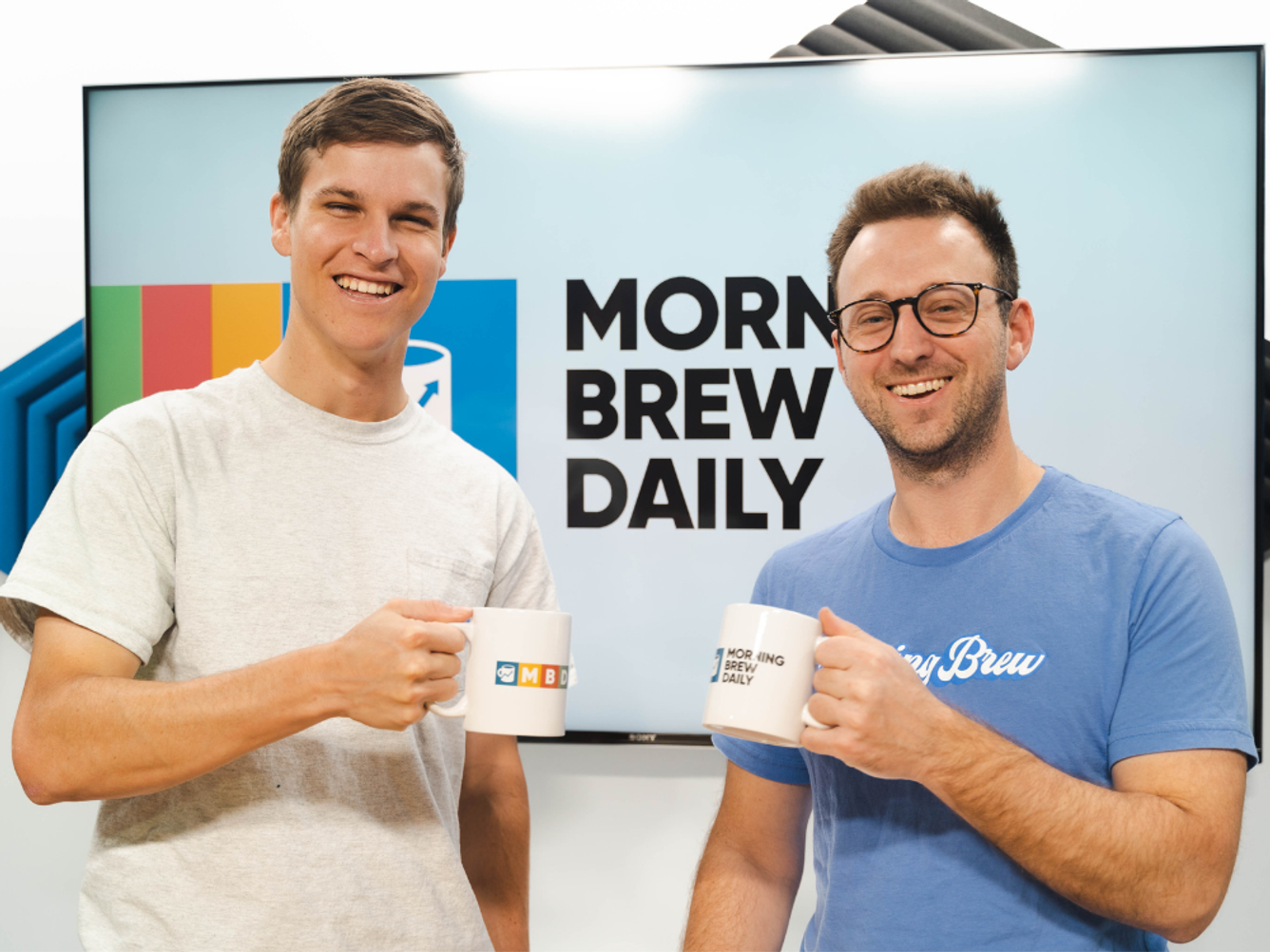
FROM THE CREW You’re already reading the newsletter, but did you know you can also listen to and/or watch the smartest, wittiest takes on business news? Morning Brew Daily hosts Neal Freyman and Toby Howell have you covered on everything you need to know before your cup of coffee, from the latest headlines on the economy to explanations of viral TikTok trends. You’ll look so smart in front of your friends. New episodes are released every weekday at 7am ET. Check ’em out on YouTube or wherever you get your podcasts. |
|
|
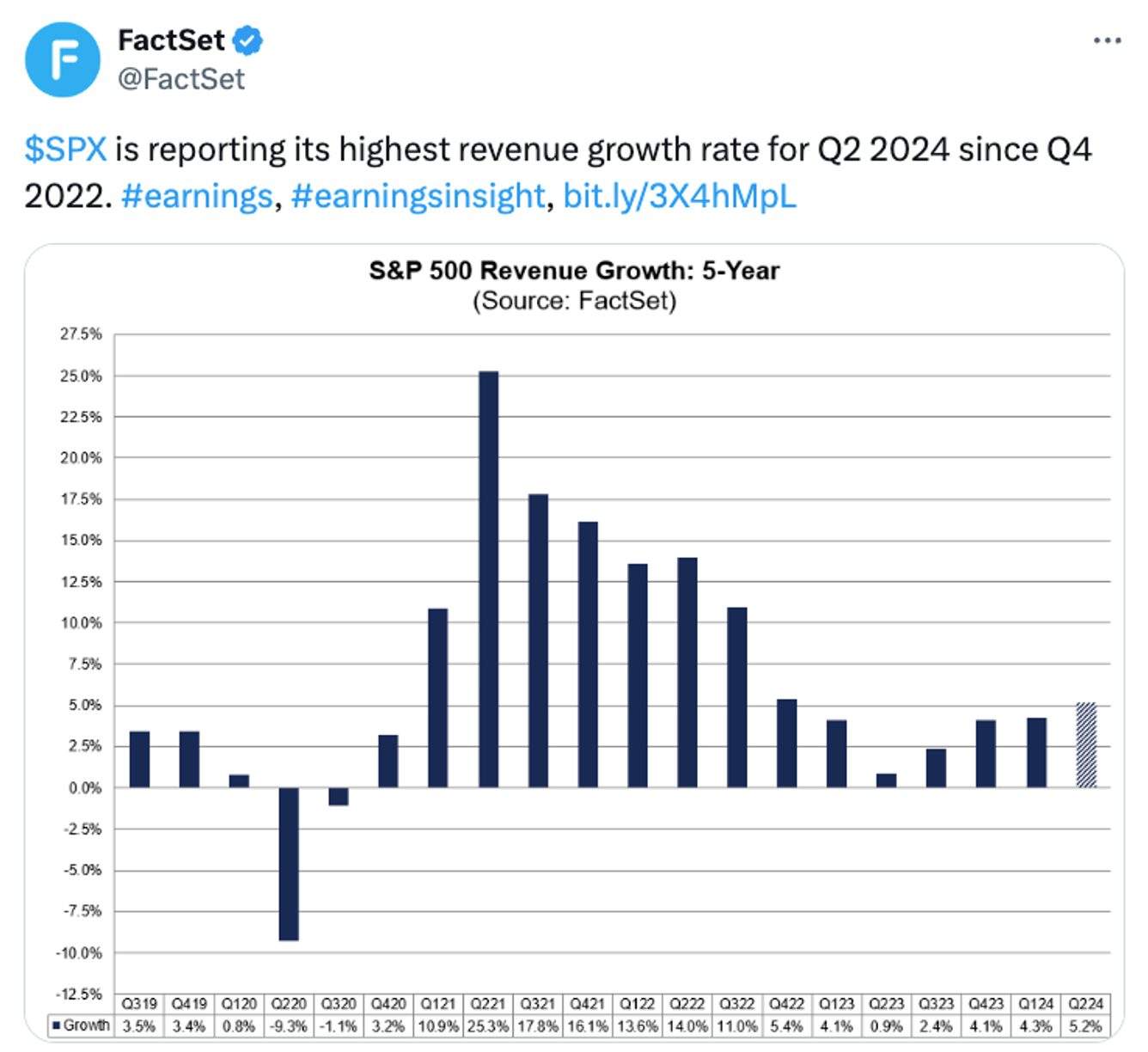
X MARKS THE SPOT Earnings season is just about over, so it’s time to tally up the damage. As the chart from FactSet above illustrates, this has been a very lucrative quarter for a large chunk of the S&P 500. With the majority of the index having already reported, the S&P 500 is on track to report 5.2% revenue growth this quarter—that would be the highest rate of growth since the 5.4% of Q4 2022. “It will also mark the 15th consecutive quarter of revenue growth for the index,” according to a recent FactSet report. “This would tie the mark with Q3 2016 through Q1 2020 for the longest period of consecutive quarters of (year-over-year) revenue growth for the S&P 500 since FactSet began tracking this metric in 2008.” All the recent volatility can make it seem like stocks are in an existential crisis—but if the latest round of earnings reports reveals anything, it’s that most of the market is doing just fine. |
|
|
STOCKS 🟢 What’s up  What’s down What’s down
- Peloton Interactive stumbled 4.64% on the news of a deal allowing Google’s Fitbit users to have access to Peloton classes.
- Brinker International sank 10.51% after the parent company of Chili’s announced lower-than-expected earnings last quarter.
- Ouster plummeted 27.44% after the lidar manufacturer reported disappointing revenue last quarter and forecast for worse to come next quarter.
- Starbucks fell 2.09% as investors took some profits after yesterday’s gigantic pop.
|
|
|
FIXED INCOME The word “recession” has officially replaced “inflation” as the boogeyman for investors. Enter bonds, which can offer investors downside protection during a period of stock market volatility. When things went south in equity-land during the meltdown earlier this month, bonds did their part by hedging investor losses. For example, the Morningstar US Market Index dropped 6.3% in the first week of August, while the Morningstar US Core Bond Index rose 1.5%. Highly rated bonds performed well, with yields sinking to their lowest levels in over a year last week. As a reminder: When yields fall, bond prices rise, and vice versa, which is why lower yields result in positive returns for bond investors. Should you turn to bonds? After years of investors only seeing gains from a select segment of their investment portfolio (we’re looking at you, Magnificent 7) a classic 60% stocks, 40% bonds portfolio has proven to be wise in light of recent volatility. Investors have caught on quickly to the benefits of bonds, pumping billions of dollars into fixed income mutual funds and ETFs as the fear of a recession continues to rise. Shareholders have added nearly $9 billion to US government and corporate bond funds in August so far. Yet while investors are anxious about a recession, most economists still foresee a soft landing. Either way, bonds are an important part of a well-balanced portfolio, and it’s not a bad idea to lock in high yields from long-term fixed income investments before interest rates are cut. But not all fixed-income options are the same. While cash equivalents such as money market funds and short-term yields were advantageous when inflation was high and the Fed was raising rates, now is the time for investors to think long-term. “As returns on cash are eroded, we think investors should consider investing cash and money market holdings into high-quality corporate and government bonds as well as diversified fixed income portfolios,” wrote Chief Investment Officer Americas at UBS Global Wealth Management Solita Marcelli in a note today. “These assets have recently shown their value, cushioning volatility in equity markets.”—LB | | |
|
|
NEWS - Thank goodness we avoided the bacon apocalypse.
- US antitrust regulators are considering a wild move: breaking up Google.
- But big tech isn’t going to take regulation lying down: Amazon is claiming that the National Labor Relations Board is violating the Constitution.
- Intel sold its stake in AI chipmaker Arm Holdings last quarter to the tune of $148 million as the company struggles to remain relevant in a new tech era.
- More people are using AI when they apply to jobs, leading to more applications per job, giving employers serious headaches.
- Earnings season is wrapping up, and these 5 cheap stocks crushed it.
|
|
|
CALENDAR There’s still a few more reports coming out this week, though after today’s major CPI report everything else just feels kind of meh. One of the key data points to watch is US retail sales, which are expected to rise about 0.3% in July. Retail sales have remained shockingly resilient in the face of high inflation, helping the US economy sidestep a recession. But if the labor market is stumbling the way some think, then consumers will have less cash on hand to spend, and this report could reflect that. Other reports include both the Empire State Manufacturing Survey and the Philadelphia Manufacturing Business Outlook Survey, as well as the Import Price Index (CPI and PPI’s weird cousin).  Before the open Before the open
- Walmart (WMT) is the largest retailer in the country, yet it keeps finding ways to grow even bigger. The company has expanded into e-commerce in a big way, and has plans to utilize AI throughout its supply chain. Throw in steady revenue growth at Sam’s Club, plus strong margins in spite of higher costs thanks to inflation, and it’s no wonder that 27 out of 30 Wall Street analysts covering the stock rate it a buy. Consensus: $0.64 EPS, $168.57 billion in revenue.
- Alibaba (BABA) is China’s answer to Amazon, but unlike that big tech behemoth, Alibaba shares have treaded water all year. Shareholders will want to hear more about the company’s plans to handle the massive economic slowdown that China is still contending with, as well as any growth opportunities abroad. If they like what they hear, then that stock’s cheap valuation may be its ticket to a big pop higher. Consensus: $2.11 EPS, $34.46 billion in revenue.
- Deere (DE), like other home improvement and tool companies, enjoyed a big pop in 2020 and 2021 as homeowners looked to spruce up their property. But a lot of that demand has evaporated, sending shares slowly but steadily lower this year. With yesterday’s report from Home Depot citing slower consumer spending ahead, shareholders may want to brace themselves for a difficult quarterly report. Consensus: $5.77 EPS, $10.94 billion in revenue.
 After the close After the close
- H&R Block (HRB) takes advantage of taxpayer confusion by simplifying the process, and its tight grip on that enormous market has helped send the stock higher and higher this year. But there’s a growing impetus among Americans for cheaper, self-filing options, and the US government is already exploring how to implement those alternatives. Shareholders will want to hear about H&R’s plan for a world where US citizens can file their taxes for free elsewhere. Consensus: $1.74 EPS, $1.03 billion in revenue.
|
|
|
COMMUNITY Look, we get it: It’s been a weird, wild, wacky August. Usually one of the slower months of the year, with many pros still wrapping up their summer vacations, this has turned out to be the most volatile two weeks of 2024—and unfortunately, it doesn’t seem like things will calm down anytime soon. So we wanted to check in with you and see how you’re doing. There’s no better way to keep a finger on the market’s pulse than to go straight to the people. Take our survey here so we can get a sense of your state of mind, and so you can give us some feedback on what you’d like us to cover in more depth going forward. After all, if you’ve got questions about today’s markets, we’d love to do our best to answer them! |
|
|
|
ADVERTISE // CAREERS // SHOP // FAQ
Update your email preferences or unsubscribe .
View our privacy policy .
Copyright © 2026 Morning Brew Inc. All rights reserved.
22 W 19th St, 4th Floor, New York, NY 10011 |
|