| | | | | | | | Data is provided by |  |
*Stock data as of market close, cryptocurrency data as of 4:00pm ET. Here's what these numbers mean. | - Stocks: Markets struggled to pick a direction as investors took a wait-and-see approach ahead of tomorrow’s CPI reading—even as Wall Street worries about the data’s reliability.
- Trade: President Trump asked China, the world’s largest soybean buyer, to quadruple its soybean purchases from the US. He also extended the trade war truce with China by 90 days
- Commodities: Gold had its worst day in three months as traders waited for the White House to clarify its new tariffs on the key commodity—only for Trump to announce that it won’t be tariffed at all. Meanwhile, Chinese battery giant CATL halted operations at a mine that produces 4% of the world’s lithium, sending prices of the precious metal soaring.
| |
|
|---|
INVESTING Once derided as a fringe movement, like Magic: The Gathering or pickleball, crypto is now fully mainstream. Crypto has been gaining steam after several of its biggest opponents were replaced by the Trump administration, lawsuits against major players were dropped, and a series of ETF debuts gave it a foot in the door of the financial world. That door was kicked wide open last week when President Trump signed an executive order instructing the Labor Department and SEC to review guidance for retirement account managers about allowing alternative investments like cryptocurrencies into 401(k)s. All of this recent success has propelled the total crypto market cap above $4.1 trillion today, a new all-time high. Bitcoin is up 3.36% in the last week, rose above $120,000 earlier this afternoon, and remains inches away from a new record. Altcoins are even hotter: Ethereum just popped above $4,000 for the first time in years, and has climbed 15.49% in the last five days. Meanwhile, crypto trading platform Coinbase gained 2.92% today. Crypto has finally arrived. The only question now is, what comes next? The spotlight is blinding investors to dangers A few things are clear: Adoption isn’t slowing anytime soon, even as the classic crypto risks remain. The ability for companies to reinvent themselves as crypto treasuries and rake in investor money means the trend is here to stay. Just the other day, Trump-backed World Liberty Financial announced it’s partnering with a small blockchain company called ALT5 Sigma Corporation to effectively establish a $1.5 billion crypto treasury. That’s not the only recent crypto news. Big banks and retailers alike are exploring stablecoin adoption, searching for ways to capitalize on that form of crypto’s latest legal success. Lenders may soon consider crypto assets when they’re assessing a borrower’s loan application. And Robinhood and Coinbase are trying to tokenize stocks, bringing publicly traded companies onto the blockchain. The hype is extraordinarily high, but not everyone is gung-ho about crypto. Some pros note that the guardrails protecting the financial system from crypto volatility are being dismantled too quickly, and that betting big on the nascent asset remains risky. For example: ALT5, the company partnering with World Liberty Financial, soared over 42% when the news was announced last week. It plummeted 26.5% today. But these days, it’s not just the twists and turns of an individual stock or crypto coin that investors need to prepare their portfolios for. The last crypto crash in 2022, spurred on by the collapse of FTX, was contained to the crypto ecosystem. With regulators, publicly traded companies, and soon retirement accounts all-in on crypto, that won’t be the case the next time bitcoin takes a nosedive.—MR | | |
|
|
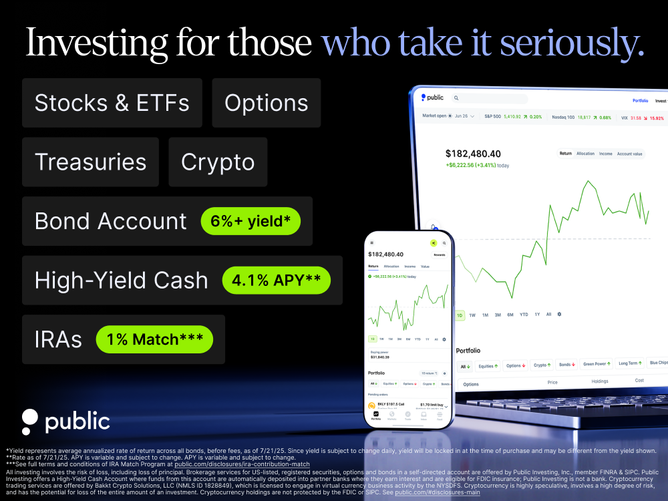
Presented by Public.com Ready to diversify your portfolio? Public is the investing platform designed for those who take it seriously—so you can trade like a professional. With Public, you can build a multi-asset portfolio of stocks, bonds, options, crypto, and more. Want access to industry-leading yields? Earn 4.1%* APY on your cash with Public’s high-yield cash account, no fees or minimums. Lock in a 6%** or higher yield with a diversified portfolio of corporate bonds or build your own Treasury ladder. And AI is woven into the entire Public experience, so you can access smart context at every touchpoint. With their AI co-pilot, Alpha, you can ask questions about any stock. Plus, for a limited time, you can earn a 1% match on all IRA deposits, IRA transfers, and 401(k) rollovers. Sign up for Public today and fund your account in five minutes or less. |
|
STOCKS 🟢 What’s up - Fannie Mae and Freddie Mac rose 14.89% and 13.66%, respectively, after President Trump posted an AI-generated image of himself ringing the bell at the NYSE, suggesting the two mortgage giants could be combined into one stock with the ticker MAGA.
- Pot stocks got high on their own supply after Trump told reporters that he may soon reclassify marijuana in “the next few weeks.” Canopy Growth soared 26.4%, Tilray Brands jumped 41.82%, and Cronos Group gained 16.9%.
- Tesla rose 2.84% on the news that it has launched a bid for an energy license in Britain that would allow it to enter the UK energy market.
- AMC Entertainment climbed 2.9% after the movie theater chain/meme stock reported a smaller-than-expected loss last quarter.
- Mega miner Albemarle popped 6.97% after a Chinese lithium giant halted production, cutting the supply of the precious metal.
- The live sports blitz continues: Paramount has acquired the rights to UFC for $7.7 billion over the next seven years. Parent company TKO Group rose 10.32%.
- Tegna soared 29.92% on reports that the television station operator will be acquired by Nexstar Media Group.
 What’s down What’s down
- Ce.ai plunged 25.6% after the AI software maker missed Wall Street analyst estimates by a mile last quarter thanks to its CEO’s health struggles.
- Hershey dropped 4.85% after cocoa futures surged the most since December as traders worried about a weak West African crop.
- Barrick Mining Co. fell 2.56% after the Canadian miner posted a net charge of over $1 billion due to its mine in Mali being seized by the military junta.
- Monday.com beat earnings estimates and raised its fiscal guidance, but the workflow management company lost 29.8% after that guidance came in lower than expected.
|
|
|
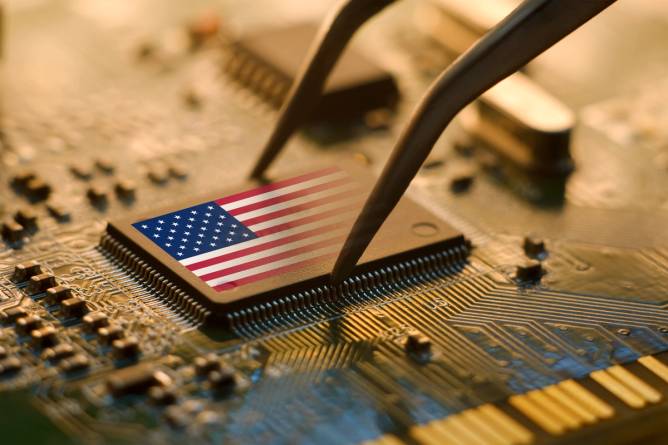
STAT OF THE DAY President Trump channeled Missy Elliott over the weekend when he decided to take the tariff on semiconductors, flip it, and reverse it. Nvidia and AMD have agreed to pay the US government a reverse tariff of 15% of their revenue from the sale of semiconductor chips to China. In exchange, the two companies will once again be allowed to export their made-for-China chips. Though it will cost them billions of dollars, the deal isn’t necessarily a bad one for Nvidia and AMD. Analysts are bullish on the idea that these companies will have access to the massive Chinese market: The Financial Times noted that Nvidia would have made an additional $23 billion in revenue this year if it had been allowed to sell its H20 chip in China, and Melius Research analysts calculated that AMD could earn $3 billion per quarter from Chinese sales of its MI308 chip. But while a reverse tariff isn’t unheard-of, there’s no precedent for it in US history—and the idea has rattled C-suites around the world, who now know that the White House could demand a chunk of their revenue if they want to keep doing business. One such CEO in the hot seat today: Intel’s Lip-Bu Tan, who has come under fire recently for his Chinese business dealings. The chief executive will visit the White House this afternoon to mend fences with President Trump and likely attempt to secure a deal of his own.—MR |
|
|
BIG PICTURE You may think that with the stock market consistently hitting fresh record highs, the number of public companies listed has climbed the charts in tandem. But that’s not the case. In fact, the number of public companies listed on US exchanges reached a peak in 1997—and that number has been declining since. We’ve written about the resurgence in the IPO market, with splashy debuts from former unicorns like CoreWeave, Circle, and Figma. But while that may make it seem like there’s a healthy pipeline of private companies that want to go public, there’s a deeper trend that’s concerning experts like Reena Aggarwal, professor of finance at Georgetown’s business school. Although the US has the biggest stock market by market cap, the nation has the fourth most publicly listed companies, lagging behind China, the EU, and Japan. While the number has zig-zagged over the years, dropping sharply with the dot com bust and spiking during the SPAC boom of 2023, there are now roughly 3,838 public companies in the US, according to Aggarwal. That’s down from 7,522 public companies in 1997. Why does this matter? “Public markets play a really important role in the financial economics and competitiveness of a country,” Aggarwal explained in an interview with Brew Markets. That’s why Aggarwal recently published a paper on the very topic. She isn’t the only one who's noticed: Everyone from JPMorgan CEO Jamie Dimon to leading economists are worried that companies are putting off their public debut—or just staying private permanently. Why fewer companies are going public One obvious reason firms are choosing to stay private longer: There’s more private capital ready to be deployed than ever before. “Why do I want to be a public company if I can get private capital easily, quickly, and at good terms?” explained Aggarwal. That sweet, sweet shareholder money doesn’t hold the same allure these days, either. Companies are exploring new ways to open private companies to public funding, whether that’s Robinhood offering tokenized shares of OpenAI and SpaceX, or JPMorgan expanding its research coverage to private companies. Aggarwal also pointed to regulatory requirements, threats of litigation, and the rise of shareholder activism—just to name a few of the reasons companies are hesitating to hit the public market. In short: If the funding is available, it's just plain easier to be a private company these days. Her suggestions for policies that would encourage more companies to go public get at that very idea—if it's less expensive and onerous to be listed on a US exchange, more firms will jump in the public market waters. Some of the recommendations she proposed include limiting disclosures and regulatory requirements, and streamlining the proxy voting process to make it more efficient. Or, maybe just the prospect of being named in Brew Market’s movers and groovers section will be motivation enough.—LB | | |
|
|
Together With Crypto 101 Pro tips galore. Come with questions and leave with insights at the Crypto Hedge Fund Summit. This free, three-day online event brings together some of the world’s best traders to discuss what’s working in the market right now, how to trade like a hedge fund (no matter your experience), and more. Save your spot. |
|
NEWS - Federal Reserve Governor Michelle Bowman is pushing for three interest rate cuts this year.
- Forget quiet luxury: Struggling high-end retailers are looking to make a splash to catch consumers’ attention.
- Oh, the irony: One of the most active stock traders in Congress is the guy who called for stock trading to be banned in Congress.
- Fox and Disney are joining forces to offer their new streaming services in one bundle for $29.99.
- The good news: It’s actually a great time to buy a house. The bad news: That’s according to a Zillow economist.
- Electric vehicle sales are surging as customers race to buy EVs before the $7,500 tax credit expires on Sept. 30. To wit: Ford announced it’s pouring $2 billion into expanding an EV assembly plant in Louisville, KY.
|
|
|
CALENDAR We’ve got a few interesting earnings reports to watch tomorrow including ON Holdings, CoreWeave, Circle Internet Group, eToro, and H&R Block. But all eyes will be glued to the latest inflation data. Tomorrow’s July CPI report is a critical one, for a number of reasons. After President Trump fired the head of the BLS for a weak jobs report, market watchers think he’ll step up the rhetoric against Jerome Powell if inflation comes in higher than expected. But no matter what he says, prices are still expected to climb as tariffs begin to take their toll. Economists anticipate a 0.2% increase month over month and a 2.8% annual increase to headline CPI. Meanwhile core CPI, which excludes volatile food and fuel prices, is expected to rise 0.3% on a monthly basis and 3% year over year. Expect prices to keep rising as the summer comes to an end. Goldman Sachs chief economist Jan Hatzius wrote today that, while US companies have so far borne the brunt of tariff costs, that can’t last forever—and once companies begin hiking prices, Americans are going to feel the burn. “We find that US consumers had absorbed 22% of tariff costs through June but that their share will rise to 67% if the recent tariffs follow the same pattern as the earliest ones,” Hatzius warned. |
|
|
RECS  After 34 years, AOL will discontinue its dial-up service. RIP to the OG. After 34 years, AOL will discontinue its dial-up service. RIP to the OG.
 Brew Markets is all you need, but just in case, here are the 60 best investing blogs of 2025. Brew Markets is all you need, but just in case, here are the 60 best investing blogs of 2025.
 2 Warren Buffett stocks to buy before Berkshire Hathaway’s 13F filing next week. 2 Warren Buffett stocks to buy before Berkshire Hathaway’s 13F filing next week.
 How much money would it take to convince you to move to Noblesville, Indiana? It's one of many cities enticing workers with some serious cash. How much money would it take to convince you to move to Noblesville, Indiana? It's one of many cities enticing workers with some serious cash.
 Combining Oreos and Reeses sounds simple. It turned into the Manhattan Project of snacks. Combining Oreos and Reeses sounds simple. It turned into the Manhattan Project of snacks.
 Trade like a pro: Public is the investing platform for serious investors. With its modern, intuitive platform and AI-enabled touchpoints, you can build a multi-asset portfolio with confidence. Learn more.* Trade like a pro: Public is the investing platform for serious investors. With its modern, intuitive platform and AI-enabled touchpoints, you can build a multi-asset portfolio with confidence. Learn more.*
*A message from our sponsor. |
|
|
✢ A Note From Public.com All investing involves the risk of loss, including loss of principal. Past performance does not guarantee future results. This ad is not a recommendation or offer to buy/sell securities or engage in any investment strategy. Investment advisory services for Treasury Accounts are provided by Public Advisors, an SEC-registered investment adviser. Brokerage services for treasuries in a Treasury Account and US-listed securities, options, and bonds in a self-directed brokerage account are offered by Open to the Public Investing, member FINRA & SIPC. Public Advisors and Public Investing are affiliates. Public Investing offers a High-Yield Cash Account where funds from this account are automatically deposited into partner banks where they earn interest and are eligible for FDIC insurance; Public Investing is not a bank. Alpha is an experimental tool offered by Public Holdings; please independently verify the accuracy of any output. Cryptocurrency trading services are offered by Bakkt Crypto Solutions (NMLS ID 1890144), which is licensed to engage in virtual currency business activity by the NYSDFS. Cryptocurrency is highly speculative and involves a high degree of risk. Cryptocurrency holdings are not protected by the FDIC or SIPC. For more details, see public.com/#disclosures-main. *As of 7/14/25. Rate variable and subject to change. **This yield is the average, annualized yield to worst (YTW) across all ten bonds in the Bond Account, before fees, as of 7/14/2025. Because the YTW of each bond is a function of that bond’s market price, which can fluctuate, your yield at time of purchase may be different from the yield shown here and your YWT is not “locked in” until the time of purchase. A bond’s YTW is not guaranteed; you can earn less than that YTW if you do not hold the bonds to maturity or the issuer defaults. As part of the IRA Match Program, Public Investing will fund a 1% match of: (a) all eligible IRA transfers and 401(k) rollovers made to a Public IRA; and (b) all eligible contributions made to a Public IRA up to the account’s annual contribution limit. The matched funds must be kept in the account for at least 5 years to avoid an early removal fee. Match rate and other terms of the Match Program are subject to change at any time. See full terms here. ✳︎ A Note From Crypto 101 © 2025 Boardwalk Flock LLC. All Rights Reserved. 2382 Camino Vida Roble, Suite I Carlsbad, CA 92011, United States The advice and strategies contained herein may not be suitable for your situation. You should consult with a professional where appropriate. Readers acknowledge that the authors are not engaging in the rendering of legal, financial, medical, or professional advice. The reader agrees that under no circumstances Boardwalk Flock, LLC is responsible for any losses, direct or indirect, which are incurred as a result of the use of the information contained within this, including, but not limited to, errors, omissions, or inaccuracies. Results may not be typical and may vary from person to person. Making money trading digital currencies takes time and hard work. There are inherent risks involved with investing, including the loss of your investment. Past performance in the market is not indicative of future results. Any investment is at your own risk. ✤ A Note From Public.com *All investing involves risk. Brokerage services for US listed securities, options, and bonds in a self-directed brokerage account are offered by Open to the Public Investing Inc, member FINRA & SIPC. Not investment advice. |
|
|---|
|
ADVERTISE // CAREERS // SHOP // FAQ
Update your email preferences or unsubscribe .
View our privacy policy .
Copyright © 2025 Morning Brew Inc. All rights reserved.
22 W 19th St, 4th Floor, New York, NY 10011 |
|