|
We weren’t joking yesterday when we said we’d be at the Nvidia earnings party, which was a real thing that happened.
We laughed, we cried, we felt the palpable enthusiasm that only finance bros out of the office and drinking at 4:30pm on a Wednesday could bring. Our very own video star Meg surveyed how many people there actually know what Nvidia does, and fellow newsletter writer Sam celebrated the chipmaker’s results a little too enthusiastically.
For Nvidia’s next earnings report, Brew Markets is hosting the party at Morning Brew HQ. Consider this your formal invitation, unless Neal thwarts our plan, in which case you didn’t hear it from us!
—Mark Reeth & Lucy Brewster
|
|
|
|

|
Nasdaq
|
17,516.43
|
|
|
|
|
S&P
|
5,591.96
|
|
|

|
Dow
|
41,335.05
|
|
|
|
|
10-Year
|
3.867%
|
|
|
|
|
Gold
|
$2,554.80
|
|
|
|
|
Oil
|
$75.95
|
|
|
| Data is provided by |

|
*Stock data as of market close.
Here's what these numbers mean.
|
- Stocks ended the day mixed as investors digested Nvidia’s latest earnings report. The non-tech-focused Dow rose to a record high, while the tech-heavy Nasdaq sank, with the S&P 500 splitting the difference and ending the day flat.
- Treasury yields rose as investors anticipate tomorrow’s PCE index, which will play a key role in determining the Fed’s next move. Gold gained as well, with investors using the shiny metal to hedge their bets.
- Oil popped on the news that output from Iraq will be cut, while production in Libya has sunk for three days straight.
|
|
|
|
The Washington Post/Getty Images
|
Compelling prices on absolute necessities like this $1 novelty hot dog holder still weren’t enough to save Dollar General from cutting its full-year outlook and sending its stock into a nosedive.
Shares of Dollar General (DG) fell over 30% today to about $86, the lowest the stock has closed since 2018, after the retail chain said its customers were tightening their belts.
This morning, the dollar store giant reported:
- Earnings per share: $1.70, below the $1.79 expected.
- Revenue: $10.21 billion, lower than the $10.37 billion forecast.
- Outlook: It only expects its same store sales to rise 1% to 1.6% for the fiscal year, lower than its previous forecast of a 2% to 2.7% increase.
- It also cut its full-year earnings guidance to between $5.50 and $6.20 a share, down from previous expectations of $6.80 to $7.55.
What happened?
CEO Todd Vasos blamed the poor report on weakening consumer sentiment as lower-income shoppers struggle in an economy strained by high interest rates.
“Despite advancing several of our operational goals and driving positive traffic growth, we are not satisfied with our financial results, including top line results below our expectations for the quarter,” said Vasos in a statement.
However, other retailers like Walmart said that customers were just fine in Q2, and macroeconomic data from the Commerce Department two weeks ago confirmed bargain hunters were still spending—meaning that Dollar General’s miss wasn’t just due to weakening consumer confidence.
Vasos acknowledged that the store chain needs to focus on “the importance of controlling what we can control” and could improve how it operates its stores and tracks inventory.
Can DG get back on track? If and when the Federal Reserve cuts interest rates in September, economic pressure on both customers and companies should alleviate.
But the majority of analysts have a “hold” rating on Dollar General, and it’s unclear whether the retail chain will be able to streamline its operational struggles anytime soon. However, its average price target is still $144—far higher than where the stock closed today.—LB
|
|
|
Set up a 401(k), buy a starter home, hope to retire by 65—we’ve heard it all before. But is that traditional financial advice still valid? And should it be? The Money with Katie Show is a weekly podcast that unpacks the biggest questions around millennial and Gen Z money, from the myth of the starter home to the impacts of self-care culture and the beauty industry. See why this illuminating podcast has 7m+ downloads—tune in now.
|
|
Charles Schwab
|
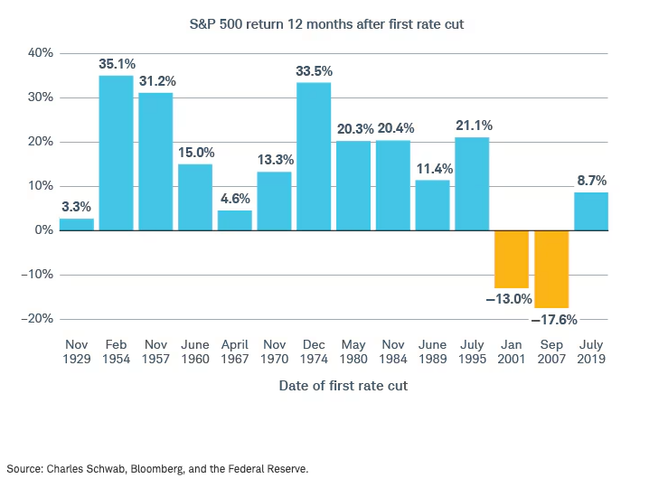
Fall is right around the corner, which means pumpkin spice lattes, football, and most exciting of all, the first interest rate cut in ages.
The Federal Reserve is almost certainly going to cut interest rates in a few weeks, and investors need to stay on their toes for what this new normal may bring to markets. In the near-term, it’s likely going to cause some serious volatility.
But in the long term, as Chief Investment Strategist Liz Ann Sonders and Senior Investment Strategist Kevin Gordon of Charles Schwab recently noted, things usually take a turn for the better.
12 of the last 14 rate cuts have meant stronger stock market returns in the following year, as the chart above illustrates.
“The two negative periods—which occurred after the Fed began cutting rates in 2001 and in 2007—may feel uncomfortably recent, but neither economic environment resembles today's; the former happened amid the dot-com implosion, and the latter was precipitated by the subprime mortgage crisis,” the Charles Schwab strategists wrote in the original report.
|
|
🟢 What’s up
 What’s down What’s down
|
|
I-Hwa Cheng/Getty Images
|
It turns out that the S&P 500 is greater than a single stock after all.
Expectations for Nvidia and the rest of the key tech stocks that have been supercharged by AI over the past two years have gotten so high that they’re pretty much impossible to meet. Even though Nvidia doubled its revenue and profit over the last quarter and beat Wall Street expectations, investors still sent the stock tumbling, fearing that the firm’s stellar growth isn’t accelerating as fast as it once was.
The other shoe didn’t drop
Despite warnings that an Nvidia-induced contagion would send major indexes into a tailspin—which makes sense, considering the stock makes up over 6% of the S&P 500—the rest of the market is actually up today.
Investors’ resilience shows that tech stocks don’t have quite the grip on the market they did only a few short months ago. As the Federal Reserve looks increasingly likely to lower interest rates, investors have moved their money beyond tech, into investments like small-cap stocks and value picks.
For example, investors have drained $67 million from the largest AI thematic fund on the market, the Global X Robotics & Artificial Intelligence ETF, just this month. That’s the biggest outflow from the fund since April.
The trend largely follows what analysts are advising: Don’t put all your eggs in one Magnificent 7 basket.
“We recommend investors examine their AI exposure as they navigate tech volatility,” wrote UBS CIO of Americas Solita Marcelli in a note yesterday.
Marcelli continued to say that if you don’t have any tech in your portfolio, consider adding some exposure. But if you already are exposed to AI, don’t go overboard, and hedge your bets.
It’s not that tech isn’t still the big kahuna, but investors are starting to realize that the other 493 stocks in the S&P 500 can grow, too.—LB
|
|
-
Remember when the market took a sharp turn south earlier this month? Economists took a look at exactly what happened minute-by-minute—and why it could happen again.
-
GDP was revised higher than expected, with the US economy growing 3% in the second quarter instead of 2.8% as originally reported.
-
Initial jobless claims fell by 2,000, bringing the four-week moving average to its lowest level since June.
-
What happens when you sell a $230 set of bedsheets for $50? Ask Macy’s, which is losing money hand over fist on the deal.
-
Berkshire Hathaway is now worth $1 trillion. The question is, should you buy the stock?
-
White-collar paychecks have been shrinking for a while, but now blue-collar pay is falling as well.
|
|
|
Earnings announcements are dwindling to a trickle, so there’s nothing big on tap tomorrow. However, there is one last enormously important economic tidbit dropping before you can clock out for the long weekend.
The Personal Consumption Expenditures Price Index, or PCE, is a key measure of inflation that analyzes the price change of goods and services across the US economy. Core PCE is a subcategory that cuts out volatile food and gas prices to give a clearer look at the underlying picture, and it’s the Federal Reserve’s preferred method of determining how the war against inflation is faring.
The battle seems like it’s almost over. At this point, the market has long been convinced that the Fed will cut interest rates at its September meeting regardless of what tomorrow’s data brings. But as the final PCE reading before the Fed makes its decision, the numbers will likely inform the size of the interest rate cut yet to come—making tomorrow’s PCE report a make-or-break moment for markets.
|
|
ADVERTISE
//
CAREERS
//
SHOP
//
FAQ
Update your email preferences or unsubscribe
.
View our privacy policy
.
Copyright ©
2024
Morning Brew. All rights reserved.
22 W 19th St, 4th Floor, New York, NY 10011
|
|