|
Good afternoon. It’s hard to believe it’s been a full year since Blackstone released its atrocious amazing annual holiday video featuring C-suite executives at the trillion-dollar private equity behemoth participating in a Taylor Swift-inspired tour.
But here we are, enjoying Blackstone’s new 2024 holiday video. This year’s video gets meta as execs disparage last year’s episode, then takes a hard left turn into a reality TV parody, before nailing the landing with a country-themed line dance through the streets of Manhattan choreographed to an original Blackstone-inspired song.
It’s worth a watch if you like cringing for eight straight minutes.
—Mark Reeth & Lucy Brewster
|
|
|
|
|
|
|
|
|
|
|
|
|
|
|
|
| Data is provided by |

|
*Stock data as of market close, cryptocurrency data as of 4:00pm ET.
Here's what these numbers mean.
|
-
The Dow snapped its longest losing streak in 50 years as stocks reele from yesterday’s sell-off.
-
Bitcoin plummeted all the way to $97,000 after a dour outlook from the Federal Reserve dashed their hopes of future rate cuts supporting future inflows.
-
Oil fell as well as investors come to terms with a hawkish Fed and fears of oversupply in 2025.
-
US GDP rose to 3.1% in the third quarter, thanks to higher exports and stronger consumer spending.
|
|
|
|
|
EARNINGS
|
It turns out not every chipmaker that AI touches immediately turns to gold.
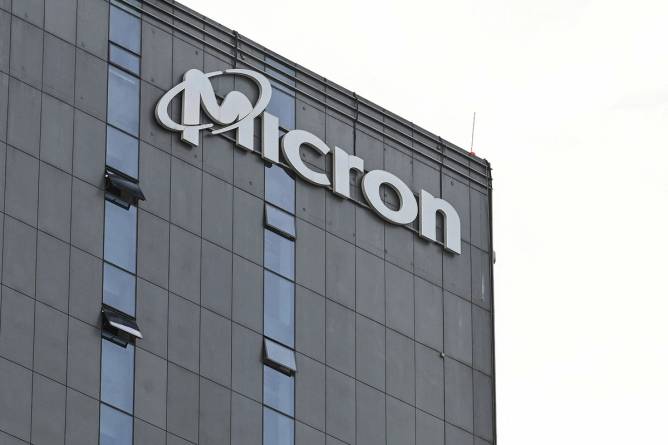
Micron, which manufactures memory chips and data storage, slipped 16.28% today after the firm reported lukewarm forward-looking guidance for its second quarter.
The not-so-great news:
- Micron reported adjusted earnings per share of $1.79, beating the $1.75 analysts expected for its fiscal Q1.
- Revenue came in at $8.71 billion, meeting analyst expectations.
- Micron expects revenue of ~$7.9 billion and adjusted EPS of ~$1.43 in the coming quarter, well below analyst expectations of $8.98 billion and EPS of $1.91.
Most of Micron’s chips are dynamic random-access memory (DRAM) chips, which are mainly used for desktop computers and servers. Its high-bandwith memory (HBM) chips, which are a subset of DRAM chips, are the good stuff: They’ve seen skyrocketing demand due to their use in building servers that power artificial intelligence. The company said on its earnings call that it expects the HBM market to top $30 billion in 2025, above its previous forecast of $25 billion.
The weak outlook wasn’t due to any slowdown from Micron’s AI data center business, but waning demand from consumers for personal electronics, including smartphones and computers.
CEO Sanjay Mehrotra acknowledged the numbers weren’t any Christmas miracle, but had a more optimistic longer-term view. “While consumer-oriented markets are weaker in the near term, we anticipate a return to growth in the second half of our fiscal year,” he said.
A tough end to an “OK” year
Before today’s earnings flop, Micron was already underperforming the S&P 500, up 22% compared to the broader market’s gain of roughly 29% in 2024.
Compare that to other AI hardware companies, such as Nvidia and Broadcom, which have gained about 174% and 102%, respectively, this year.
That said, analysts see today’s downturn as an opportunity to buy. The vast majority of analysts covering the stock give it a “buy” rating, and the average price target of $135 is 55% higher than shares are trading right now.
“We continue to believe Micron’s leadership in HBM will be transformational for margins and its market position,” explained UBS analyst Timothy Arcuri in a note.
If you’re looking for a last-minute holiday bargain for your portfolio, it might be Micron.—LB
|
|
|
|
|
|
Presented by BOXABL
|
Major car manufacturers like Ford and Tesla can reportedly build a car in as little as a minute. Isn’t it time we do that for houses?
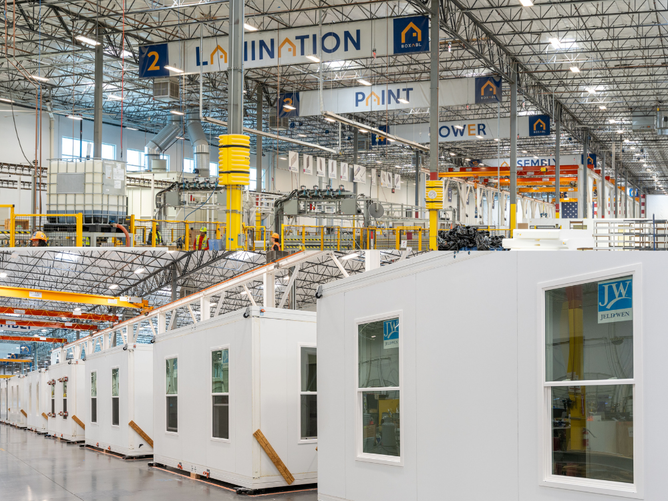
Enter BOXABL, the company that’s aiming to transform housing construction and affordability by using cutting-edge technology and advanced manufacturing methods to mass-produce homes in their Las Vegas facilities.
They believe this approach to building housing—better, faster, and more affordable—can help address the housing crisis.
BOXABL has raised more than $170m since 2020, with support from 40,000+ investors, and they have 53 patent filings. Since opening their factory, BOXABL has built 700 homes. Ready to join the mission of making housing more affordable for all?
Get the full scoop.
|
|
|
STOCKS
🟢 What’s up
-
Darden Restaurants rose 14.80% thanks to impressive same-store sales at Olive Garden and LongHorn Steakhouse, proving once again that bottomless breadsticks and pricey steaks are an unbeatable business model.
-
CarMax climbed 3.25% after the used car retailer crushed earnings expectations last quarter and increased sales for the first time in two years.
-
Accenture announced a beat-and-raise quarter after the IT services management company enjoyed strong AI bookings. Shares gained 6.99%.
-
Innodata soared 16.29% after Wedbush Securities initiated coverage of the company with a “buy” rating, highlighting its strong LLM offerings.
 What’s down What’s down
-
Lennar sank 5.23% after the homebuilder missed earnings estimates and projected lower profits ahead thanks to high mortgage rates.
-
Hims & Hers Health dropped 7.67% on the FDA’s announcement that key ingredients for weight-loss drugs from rival Eli Lilly are no longer in shortage.
-
Lamb Weston tanked 20.10% after the frozen foods producer revealed its new CEO and cut its financial guidance for 2025.
-
Vertex Pharmaceuticals tumbled 11.37% after announcing disappointing results from the Phase 2 trial of its new pain management drug for radiculopathy.
-
Quantum computing companies have enjoyed incredible gains lately, but a mix of valuation fears and profit-taking sent many of these stocks plummeting today. Quantum Computing fell 41.04%, D-Wave Quantum dropped 28.91%, and Quantum Corporation sank 39.97%.
|
|
|
|
DATA VIZ
|
A picture is worth a thousand words, so here’s two pictures for you because we like you so much.
Early yesterday, Apollo’s Chief Economist Torsten Sløk posted the chart below with the caption, “Investors are extremely bullish on the stock market, and a record-high share think that there is less than 10% probability of a crash over the coming six months.”
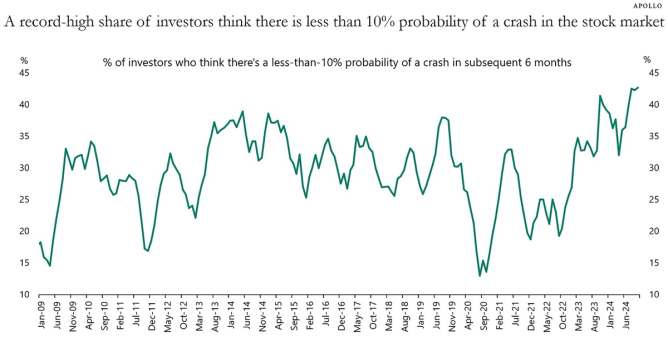 Apollo Academy Apollo Academy
Late yesterday, after the Federal Reserve disappointed investors with its 2025 rate cut outlook and the entire stock market crumbled, this happened to the CBOE Volatility Index (VIX):
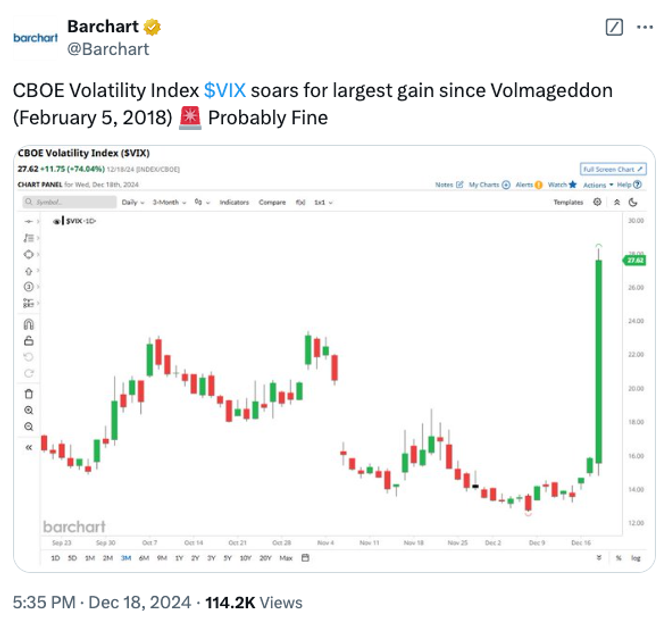 Barchart via X Barchart via X
The VIX is a gauge of investor fear, and yesterday’s 74% pop to 27.62 was the second-highest single-day surge in its history.
It can be difficult to stay calm when markets swing from blind optimism to sheer terror in a single trading session, but that’s all the more reason investors need to stick to their long-term investing plan rather than be swayed by daily moves.
|
|
|
|
MACRO
|
The new administration isn’t even officially in the White House, and we’re already watching a preview of Trump’s presidency season two.
This week, Elon Musk, who spent $277 million getting Trump elected and is now his close advisor, managed to tank a spending bill that would have kept the government open until March 14. How did he pull this off without any official legislative role? Through the power of posting, of course.
“‘Shutting down’ the government (which doesn’t actually shut down critical functions btw) is infinitely better than passing a horrible bill,” Musk posted on his platform X yesterday.
On the heels of Musk’s posts, Trump also voiced support for torpedoing the spending package that Republican House Speaker Mike Johnson negotiated. While House Republicans have reportedly come up with a compromise, if congressional Democrats or the Biden administration don’t agree to it, the government will shut down starting this Saturday.
It’s not quite that simple…
While Musk and his allies are champions of cutting government spending, the irony is that the last three federal shutdowns cost taxpayers a total of $4 billion combined.
The government has to reimburse thousands of furloughed federal workers whose paychecks stop when the government is closed. There’s also a whole host of revenue streams the government relies on, including entrance fees to national parks and even gift shop sales, that are cut off while the federal government is shuttered. For example, the National Park Service lost $7 million in revenue during 2014’s 16-day government shutdown.
The big picture: While the shutdown won’t affect your finances directly, these political shenanigans are an indicator of the infighting to come that could end up spooking investors. Along with the Federal Reserve’s hawkish cut yesterday, the shutdown is more evidence that the next four years might not be as relentlessly positive for the market as investors hoped after Trump’s re-election.
But analysts don’t seem too spooked yet: In a Wednesday note, analysts at Goldman Sachs noted that “a protracted shutdown looks unlikely in our view.—LB
|
|
|
|
|
|
Together With BOXABL
They say the next generation of housing is here. See for yourself: BOXABL wants to revolutionize housing construction and affordability by incorporating automotive manufacturing and technology innovations into housing. They’ve raised $170 million since 2020 and earned support from over 40,000 investors. Ready to help change housing forever? Join the mission today. |
|
|
NEWS
-
Home sales rose 6.3% in November, the largest annual gain in three years.
-
Remember when the Japanese yen helped tank US markets back in August? One analyst thinks we don’t need to worry about that anymore.
-
Amazon workers at seven facilities are on strike, taking advantage of the key holiday shipping season to bolster their position.
-
CFOs are beginning to embrace bitcoin, though many still view the crypto with suspicion.
-
Manchester, New Hampshire was the most popular housing market of 2024.
-
Over 650 new ETFs launched this year—here are the best and the worst of them.
|
|
|
|
TOMORROW
|
We’ve got one last major economic report hitting the wire tomorrow before we kick off two straight weeks of holidaycious market disruption. The Personal Consumption Expenditures price index, or PCE, is the Fed’s favorite way to measure inflation—particularly Core PCE, which cuts volatile food and energy prices out of the equation.
October PCE rose 2.3% year over year, while Core PCE climbed 2.8%. Both were mildly higher than the September reading, but both were in line with economist expectations. The pros forecast another slow-but-steady increase in November: Overall PCE should rise 2.5% annually, while Core PCE is expected to climb 2.9%.
Any reading below those estimates will probably mean a smooth ending to 2024. Any reading above those estimates is sure to kick off some serious panic among investors worried that the Fed cut rates too quickly. Stay tuned!
 Before the open Before the open
-
Carnival Corp. is riding the wave of analyst expectations. Wall Street believes 2025 will be another banner year for the cruise industry, and Carnival is positioned to be a top beneficiary from higher consumer discretionary spending. Historically high booking prices haven’t stopped people from penciling in a summer cruise in record numbers, and when you combine that with Carnival’s reasonable valuation, it’s no wonder that 16 of the 20 analysts covering the stock rate it a “buy.” Consensus: $0.07 EPS, $5.91 billion in revenue.
-
Winnebago Industries promises a much different sort of vacation than Carnival, and the RV manufacturer has had a much different year. The company profited during the pandemic as people tried to get away from crowded metro areas, but shares have tanked ever since rising interest rates made RVs more unaffordable. The stock is down nearly 30% in 2024 as the company struggles to reverse a dramatic multi-year decline in revenue, but until rates get even lower, there’s not much hope on the horizon. Consensus: $1.18 EPS, $789 million in revenue.
|
|
|
ADVERTISE
//
CAREERS
//
SHOP
//
FAQ
Update your email preferences or unsubscribe
.
View our privacy policy
.
Copyright ©
2024
Morning Brew. All rights reserved.
22 W 19th St, 4th Floor, New York, NY 10011
|
|