|

|
|
Good afternoon. Big thanks to everyone who submitted their bid for a patented Morning Brew Freak in the Sheets mug last week. We had a ton of fantastic referrals sent out all over the world, and it was tough to narrow down the most creative efforts.
Some of the highlights include:
-
Victoria J., who took to TikTok to spread the word through the Spanish-speaking ESL community.
-
Beck G., who spammed his clan chat in Clash of Clans with a referral link.
-
Cade W., who tried to pull some reverse psychology tricks and offered to buy mugs to send to us instead.
-
Barbara S., who abused her power and strong-armed her summer interns into signing up for the newsletter.
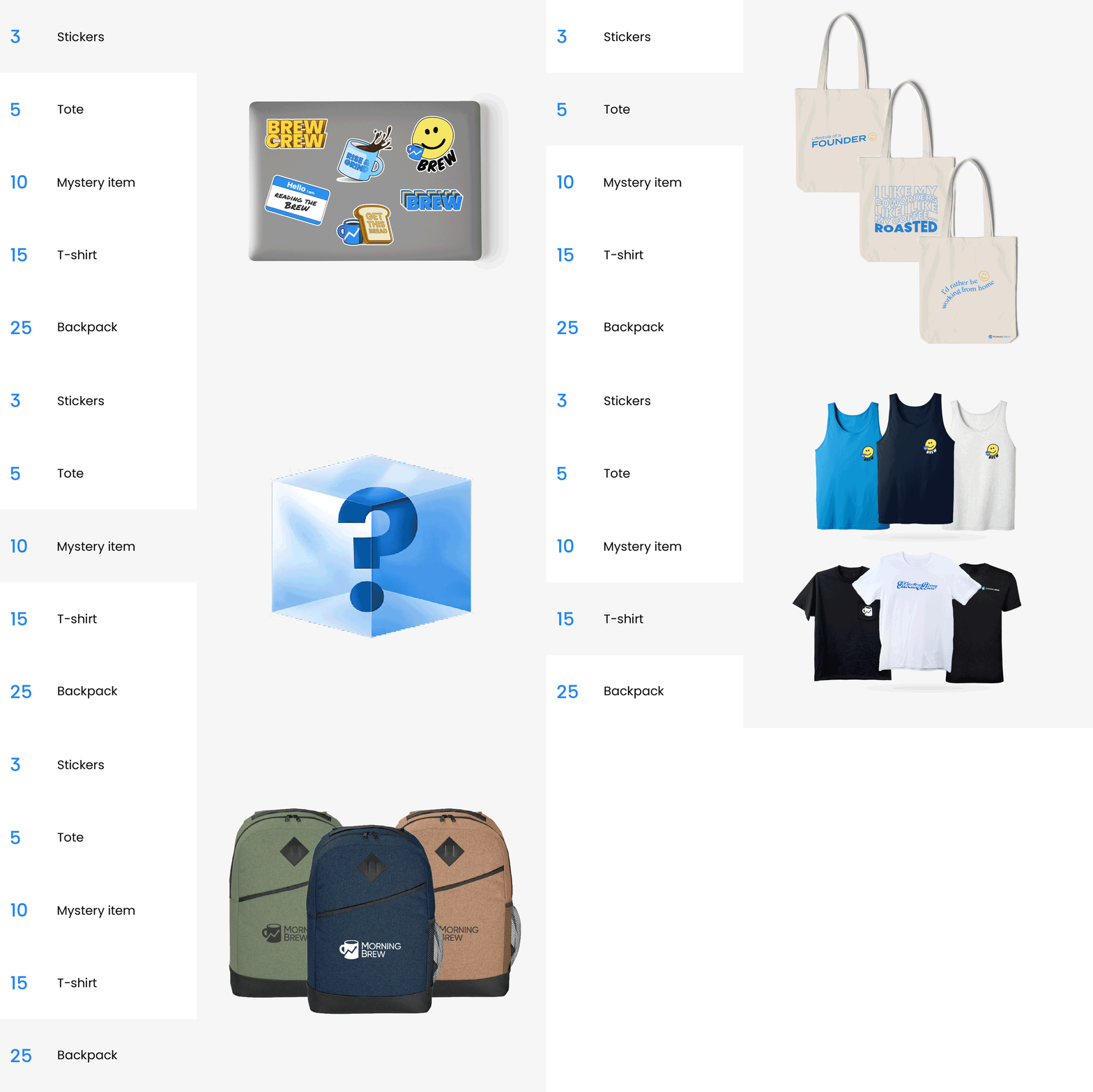
Congrats to all of our winners, and thank you again to everyone who shared Brew Markets with their networks. Just because our mug giveaway is over doesn’t mean you have to stop here—use your referral link at the bottom of this newsletter any time and earn your way to tons of great swag.
—Mark Reeth & Lucy Brewster
|
|
|
|

|
Nasdaq
|
16,195.81
|
|
|
|
|
S&P
|
5,199.50
|
|
|
|
|
Dow
|
38,763.45
|
|
|

|
10-Year
|
3.968%
|
|
|
|
|
Oil
|
$75.41
|
|
|
|
|
Bitcoin
|
$55,009.09
|
|
|
| Data is provided by |

|
*Stock data as of market close, cryptocurrency data as of 4:00pm ET.
Here's what these numbers mean.
|
- Indexes looked set to continue their rally early today, only to falter later in the trading session and fall back into the red. All three indexes ended the day squarely in negative territory as volatility continues to give investors whiplash.
- Treasury yields popped higher today as investors sold out of bonds (remember, yields rise when bond prices fall).
- Oil rocketed higher, fueled by fears of geopolitical conflict between Israel and Iran hurting supply. For reference, Iran produces 3% of the world’s oil supply.
-
Bitcoin continued to struggle today. The reason? It’s a ghost month.
|
|
|
|
Picture alliance/Getty Images
|
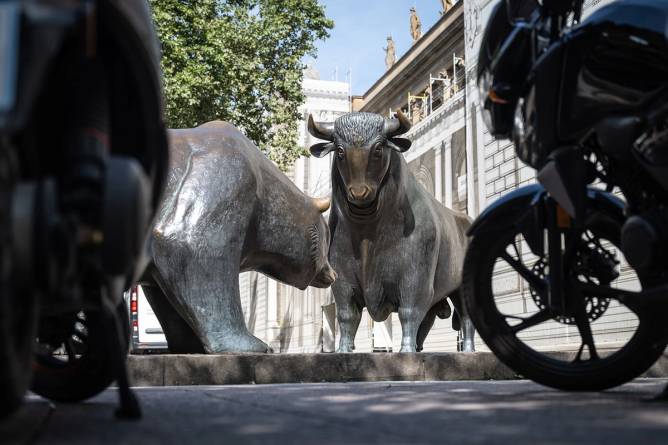
Yes, the sun rose and the world kept turning even after indexes fell a couple of percentage points on Monday.
In fact, in spite of today’s market unease, stocks have already recovered many of their losses. There’s really only one question investors are asking at the moment: How should I invest now?
We’ve said it before but we’ll say it again: Taking the emotion out of investing is the most effective way to stay in the game for the long haul. But a volatile market can also create unique opportunities.
Here is how the top analysts on the Street say you should play this upswing:
-
Wells Fargo’s Senior Global Market Strategist Scott Wren clarifies we are not in a recession, despite the fact that you’ve probably been hearing the “R” world float around a lot recently. However, he warns that there’s still volatility ahead. Wren recommends US large-cap stocks over small caps and international stocks. He added that IT and communication services are overvalued.
-
Bank of America also remains bullish on large caps, specifically value stocks. The bank’s research team added that they prefer the “Other 493” names in the S&P 500 over the expensive Magnificent Seven. They went searching for low-beta, high-quality stocks in the S&P 500 that have solid fundamentals, highlighting Alliant Energy Corp, Procter & Gamble, and Costco as examples of particularly stable investments.
-
UBS emphasized that commodities can be a great way to hedge equity risk. “Elsewhere, we continue to like gold and the Swiss franc. The Swiss National Bank looks closer to the end of its policy-easing cycle than most other central banks. We expect gold to benefit from central bank reserve diversification, investors seeking assets viewed as “safe havens,” and anticipation of faster interest rate cuts,” wrote Chief Investment Officer Americas at UBS Global Wealth Management Solita Marcelli in a note today.
-
Goldman Sachs analyst Peter Oppenheimer wrote that the firm remains “defensive” due to ongoing geopolitical instability and US election uncertainty. “We continue to prefer a policy of diversification and a combination of quality growth companies with stable cash flows … together with deep value stocks generating stable dividends and buying back stock,” Oppenheimer wrote.
The bottom line: Stay invested in quality, value, and large-cap stocks that can set you up for long-term gains, especially as the next few months are likely to be choppy waters to navigate. —LB
|
|
|
Set up a 401(k), buy a starter home, hope to retire by 65—we’ve heard it all before. But is that traditional financial advice still valid? And should it be? The Money with Katie Show is a weekly podcast that unpacks the biggest questions around millennial and Gen Z money, from the myth of the starter home to the impacts of self-care culture and the beauty industry. See why this illuminating podcast has 7m+ downloads—tune in now.
|
|
Daily Chartbook via X
|
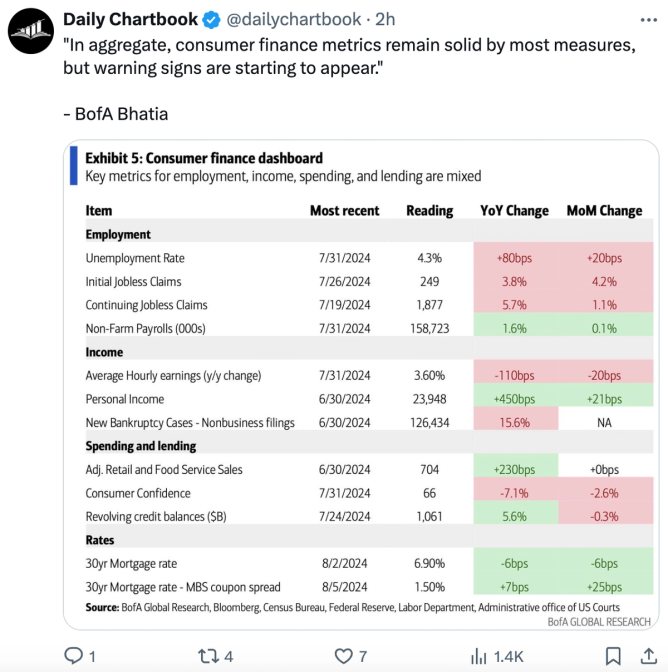
Consumer financial data, particularly employment and spending, is paramount to informing the Federal Reserve’s monetary policy—which means it’s also important for investors to understand. Unfortunately, there’s so much data floating around markets that it can be difficult to grasp it all, making charts like the one above that allow you to see the entire situation at a glance very helpful.
Daily Chartbook tweeted about a recent Bank of America report this morning providing key information about the financial health of consumers across the country. Employment and household earnings are down, but personal income is rising, while credit balances have declined recently as consumers tighten their purse strings.
Overall the situation is mixed, though still not dire. But with the Fed extremely data-dependent, and the markets extremely Fed-dependent, it pays to be informed about how consumers are doing these days in order to stay ahead of the curve.
|
|
🟢 What’s up
 What’s down What’s down
-
Super Micro Computer dropped 20.14% thanks to an earnings miss, as well as the announcement of a 10-for-1 stock split.
-
AirBnB tumbled 13.38% after not only missing analyst estimates last quarter, but warning of slowing demand in the coming quarter.
-
Lyft drove 17.23% lower in spite of strong ridership in the second quarter. Shareholders, however, did not like management’s dour financial forecast for the third quarter.
-
CVS Health sank 3.19% after it slashed its profit guidance for the full year, though it also announced a new cost-cutting program.
-
TripAdvisor took a trip south today, falling 16.61% due to a mixed earnings report and dire warnings of lower revenue in the coming quarter.
-
Amgen stumbled 5% after the biotech company missed Wall Street forecasts in the second quarter.
|
|
Kampus/Getty Images
|
 Reddit’s data licensing brought in the cash. The newly public social media forum announced its second earnings report ever since it went public via IPO in March. The firm topped Wall Street expectations for sales in the second quarter, which leapt 54% from a year earlier. Its overall revenue came in at $281 million, handily beating analyst expectations of $254 million. The company’s controversial artificial intelligence data licensing business was particularly strong; the business pushed the company’s “other revenue” category, which excludes advertising, up 691% to $28.1 million. Reddit’s data licensing brought in the cash. The newly public social media forum announced its second earnings report ever since it went public via IPO in March. The firm topped Wall Street expectations for sales in the second quarter, which leapt 54% from a year earlier. Its overall revenue came in at $281 million, handily beating analyst expectations of $254 million. The company’s controversial artificial intelligence data licensing business was particularly strong; the business pushed the company’s “other revenue” category, which excludes advertising, up 691% to $28.1 million.
 Disney’s streaming bundle finally turned a profit. The entertainment behemoth beat analyst expectations for both revenue and earnings. Its streaming businesses, which include ESPN+, Hulu, and its namesake Disney+, turned profitable in its third quarter for the first time ever. The company’s earlier guidance predicted the streaming bundle wouldn’t turn a profit in the highly competitive market until the fourth quarter of the year. But Disney’s parks and experiences hit a speed bump, as the operating income for US parks dropped 6% in the second quarter. Disney’s streaming bundle finally turned a profit. The entertainment behemoth beat analyst expectations for both revenue and earnings. Its streaming businesses, which include ESPN+, Hulu, and its namesake Disney+, turned profitable in its third quarter for the first time ever. The company’s earlier guidance predicted the streaming bundle wouldn’t turn a profit in the highly competitive market until the fourth quarter of the year. But Disney’s parks and experiences hit a speed bump, as the operating income for US parks dropped 6% in the second quarter.
 Novo Nordisk sales thinned on Ozempic earnings miss. Shares of Danish pharmaceutical giant Novo Nordisk sank 8.27% today after the company missed expectations on its sales of popular weight-loss drugs Ozempic and Wegovy. Novo reported $1.7 billion in Wegovy sales, below the $2 billion analysts expected, while Ozempic sales came in $0.2 billion lower than analyst estimates. Overall, the company reported a net profit of $1.86 billion in the second quarter, an increase of 3% year over year—but that was also below analyst estimates. Novo Nordisk sales thinned on Ozempic earnings miss. Shares of Danish pharmaceutical giant Novo Nordisk sank 8.27% today after the company missed expectations on its sales of popular weight-loss drugs Ozempic and Wegovy. Novo reported $1.7 billion in Wegovy sales, below the $2 billion analysts expected, while Ozempic sales came in $0.2 billion lower than analyst estimates. Overall, the company reported a net profit of $1.86 billion in the second quarter, an increase of 3% year over year—but that was also below analyst estimates.
|
|
-
Claudia Sahm invented the Sahm Rule, a recession indicator that was triggered late last week. But she took to Bloomberg to let us all know that her own indicator isn’t quite correct.
-
Speaking of financial folks trying to kill their own creations, Steve Mnuchin brought back 20-year bonds while he was in charge of the Treasury—now he says they need to go.
-
Speaking of bonds, this one weird indicator says that the stock market is going to be A-OK.
-
Speaking of bonds (again), there’s widespread Treasury debt market manipulation happening behind the scenes and no one is talking about it.
-
Just one last word on bonds: Warren Buffett now owns more T-bills than the Federal Reserve.
-
Let’s get back to stocks: With the Magnificent Seven still down after this week’s selloff, two of them look particularly undervalued and ripe for investment.
|
|
|
Every week, the US Department of Labor releases a report of initial jobless claims, which chronicles the number of people who applied for unemployment insurance in the previous week. The higher the number, the higher unemployment is across the country.
This simple, usually benign report has taken on new importance in light of the market’s latest moves. A worse-than-expected jobs report last Friday sent stocks tumbling on fears that the labor market was slowing faster than the Federal Reserve expected. Tomorrow’s initial jobless claims report will either add fuel to that fire or calm traders’ strained nerves.
 Before the open Before the open
-
Eli Lilly (LLY) has been soaring on the strength of Mounjaro and Zepbound, and high hopes for the burgeoning obesity drug market are keeping valuations elevated. That may be a bad thing if the company doesn’t report a boost in profits the way shareholders expect, but Wall Street is optimistic: 15 of the 18 analysts covering the stock rate it a buy. Consensus: $2.70 EPS, $9.95 billion in revenue.
-
Yeti (YETI) was an incredible success story post-pandemic, a triumphant combination of branding, marketing, and a solid product. Shares have slipped over the last year, however, as the hype fades and the domestic market has been inundated with coolers and tumblers. International growth is now the name of the game, and shareholders will want to see stronger margins this quarter as revenue reaches the bottom line. Consensus: $0.63 EPS, $452.29 million in revenue.
 After the close After the close
-
Sweetgreen (SG) is at the center of several trends right now, from consumers looking for value and not finding any at fast food rivals, to people trying to eat healthier in general. The result: Shares are up over 144% in 2024, and Wall Street analysts have an average price target another 22% higher. That valuation will need to be vindicated by strong results this quarter, and shareholders are looking forward to hearing more about the company’s automated restaurant efforts. Consensus: -$0.10 EPS, $180.91 million in revenue.
-
e.l.f. Beauty (ELF) has enjoyed a strong run since going public in 2016, predicated on its promise to sell high-quality cosmetics at reasonable prices. A strong social media presence has boosted sales, while management keeps company finances conservative. But with consumers cutting discretionary spending in light of higher inflation, it remains to be seen if the company can keep up its momentum. Consensus: $0.85 EPS, $301.44 million in revenue.
|
|
ADVERTISE
//
CAREERS
//
SHOP
//
FAQ
Update your email preferences or unsubscribe
.
View our privacy policy
.
Copyright ©
2024
Morning Brew. All rights reserved.
22 W 19th St, 4th Floor, New York, NY 10011
|
|