| | | | | | | | Data is provided by |  |
*Stock data as of market close, cryptocurrency data as of 4:00pm ET. Here's what these numbers mean. | - Stocks: The Nasdaq rose to its fifth record high of the week, while the S&P 500 and the Dow sank late in the day as investors turned their attention to the FOMC meeting next week.
- Bonds: While equities climbed all week long, the bond market has been sending signals that weak economic data really isn’t great news.
- Commodities: Oil rallied after President Trump expressed his growing frustration with Vladimir Putin and threatened further energy and financial sanctions. Meanwhile, the US may ask its G7 counterparts to apply 100% tariffs against China and India for purchasing Russian crude.
| |
|
|---|
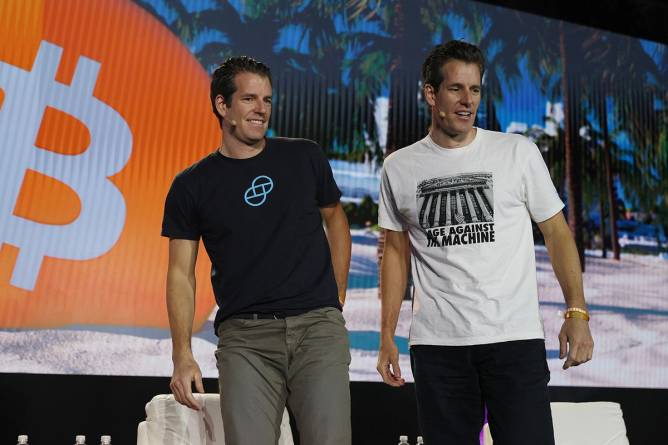
IPO Gemini Space Station may sound like a sci-fi franchise that flopped back in the 80’s, but it’s actually the brainchild of Cameron and Tyler Winklevoss (yes, those two again). Today, Gemini became the latest IPO to hit the public market, with a debut priced at $28 per share, which translates into a valuation of $3.3 billion—far above its originally anticipated range. Gemini raised roughly $425 billion by selling 15.2 million shares, according to Barron’s. Shares popped 14.29% this afternoon, ending the day priced at $32 per share. Not just another meme stock: Gemini, which was founded by the Winklevoss twins in 2014—and just so happens to be the Zodiac sign symbolized by twins—is a crypto derivatives platform, as well as a crypto exchange that allows people to buy and sell a slew of digital assets like bitcoin. Its competitors include other brokerage firms like Coinbase, Robinhood, Binance, and Interactive Brokers. While Gemini is soaring today, its actual business is more of a mixed bag. Last year, the company took a net loss of $158.5 million—though its revenue jumped 45% during the same period, according to Barron’s. Zoom out: Earlier this week, we noted that the IPO pipeline is gushing again after years of feeling more like a slow drip. Crypto IPOs in particular are seriously having a moment thanks to a new deregulatory environment and a spike in the price of bitcoin. Just look at stablecoin issuer Circle, which soared on its first day of trading in June. Or Bullish, which popped during its debut last month. Most recently, Figure soared over 40% when it started trading yesterday. One major difference between this latest IPO boom and previous ones is that retail investors are playing a bigger part. Usually, regular traders don’t have access to IPOs the same way that institutional investors do. But Gemini set aside roughly a third of its shares for the retail crowd, well above the average 6% of shares, according to the WSJ. The Winklevoss’ second act Part of Gemini’s appeal is also the fame of its founders. While they kicked off their foray into tech by feuding with Mark Zuckerberg in the early days of Facebook, Tyer and Cameron Winklevoss have moved far beyond Armie Hammer’s portrayal of them as spoiled and arrogant college rowers in The Social Network. Now, they’re bringing in some serious cash from Gemini's public debut, raking in at least $2 billion, with more likely to come. And hey, maybe they’ll get another chance at a big screen depiction in whatever movie ends up being made about the latest crypto hype cycle.—LB | | |
|
|
Presented by State Street Investment Management Get a head start on investing for the future and turn today’s money into tomorrow’s wealth. Every day, millions of investors are building toward their goals with ETFs like DIA—the only ETF that tracks the Dow. With DIA, you get 30 US blue-chip stocks in a single trade. The mega-caps that comprise the Dow Jones Index offer exposure to 172 countries and 160 different industries. |
|
STOCKS 🟢 What’s up - Tesla climbed 7.36% on hopes that Elon Musk is pivoting the EV company to robotics.
- Super Micro Computer rallied 2.39% on the news that it has begun shipping Nvidia’s Blackwell Ultra solutions chips in volume to customers around the globe.
- BigBear.ai jumped 3.9% on the announcement that the AI security company’s technology helped speed up arrivals at Nashville International Airport.
- Quantum computing stocks got a boost after UK regulators allowed IonQ to buy Oxford Ionics. IonQ gained 18.19%, while Rigetti Computing rose 14.38% and D-Wave Quantum added 7.51%.
- Black Rock Coffee Bar popped 37.65% on its first day of trading.
- Six Flags Entertainment enjoyed a rare win, rising 7.79% on reports of rising attendance at its theme parks.
- The FAA announced a new pilot program to speed up the rollout of air taxis, helping Archer Aviation rise 3.06% and Joby Aviation gain 2.34%.
 What’s down What’s down
- RH tumbled 4.82% after the furniture retailer fell short of analyst expectations this quarter and cut its fiscal forecast due to tariffs and a weak housing market.
- Boeing fell 1.85% after striking workers turned down a contract offer from the beleaguered aircraft manufacturer.
- Rent the Runway plummeted 36.38% following a much worse than expected earnings report.
- Freeport-McMoRan lost 2.6% as a key copper mine in Indonesia remains shut down following a massive mudslide.
- News that the Trump administration will link Covid vaccines to the deaths of 25 children. Pfizer fell 3.94% Moderna lost 7.4%, and BioNTech dropped 7.26%.
|
|
|
CALL OF THE DAY Remember a few weeks back when we warned that September is historically the worst month for the stock market? Well, this September is bucking the trend. The S&P 500 has enjoyed 24 record closing highs as of yesterday, which, as the analysts at Bespoke Research pointed out, is above the annual average of 18—but still a far cry from 2024’s 57 record highs. Regardless, the market’s recovery after the Liberation Day selloff has been nothing short of phenomenal, and stocks have really hit their stride in September: The S&P 500 has reached a new record high in 4 of the 10 trading days this month. Of course, the market’s massive surge has many worried that the rally may be about to run out of steam. Labor market and inflation data point to a possible oncoming recession, while the market’s massive concentration in Mag 7 stocks leaves it vulnerable to a slowdown in the AI trade. But one Wall Street bigwig still sees good things ahead. Morgan Stanley CIO Mike Wilson recently said that the US has been in a “rolling recession” since 2022, in which different parts of the economy slow at different times but the overall market keeps chugging along. He believes that a “rolling recovery” now lies dead ahead. “Bottom line, a new bull market for equities began with the trough in the rolling recession that began in 2022,” Wilson said. “It’s still early days for this new bull, which means dips should be bought.”—MR | | |
|
|
SENTIMENT It’s no happy Friyay today, at least for US consumers: The University of Michigan's latest consumer sentiment index fell for the second straight month from 58.2 in August to a preliminary reading of 55.4 in September. Today’s reading is not only the lowest since May, but also defied analysts’ expectations that the index would actually rise to 59.3. Those high hopes were likely dashed by last week’s ominous Bureau of Labor Statistics report, which showed unemployment creeping upward to 4.3%, its highest level since 2021. As the job market withers, wallets are also feeling pain amid rising inflation, with the Consumer Price Index up 2.9% year over year in August, a seven-month high. UofM’s survey also found that Americans don’t expect conditions to improve much, either, with predictions for inflation over the next year holding steady from July to August at 4.8%, and five-year forecasts rising to 3.9%. “Consumers continue to note multiple vulnerabilities in the economy, with rising risks to business conditions, labor markets, and inflation,” Joanne Hsu, the director of the Surveys of Consumers, wrote in a statement. “Likewise, consumers perceive risks to their pocketbooks as well; current and expected personal finances both eased about 8% this month. Trade policy remains highly salient to consumers, with about 60% of consumers providing unprompted comments about tariffs during interviews.” Wall Street just doesn’t care Although US consumers seem ready to curl up under the covers, investors seem more bullish than ever. How can consumer sentiment be so down when the stock market is so up? “The stock market is not the economy,” Baird investment strategist Ross Mayfield told Brew Markets. “While the US labor market might be cooling, the AI trade is firing on all cylinders and with the stock market so concentrated in Big Tech stocks, it can often be telling a different story than the economy on the ground.” Wall Street’s riding high on good odds that the Federal Reserve will cut rates during its meeting next week. This rate cut wouldn’t just be good for business, but could also improve consumers’ moods by making it easier to borrow money for big-ticket purchases like a car or a home. But that’s no guarantee, especially if people are faced with bigger-picture concerns like looming layoffs and egg prices rising to $20 a carton (again). Still, what’s good for Wall Street can trickle down to Main Street in the form of more jobs, higher wages, and fatter retirement plans. Here’s hoping that whatever happens next week puts everyone in a happier frame of mind.—JD | | |
|
|
Together With State Street Investment Management Want a smarter, more time-efficient way to invest in America’s corporate giants? Access 30 of the most reputable US companies in a single trade with DIA—the only ETF that tracks the Dow. |
|
NEWS - Microsoft and OpenAI have reached a tentative agreement to allow OpenAI to restructure from a non-profit to a for-profit company.
- Alibaba and Baidu have begun using homegrown semiconductor chips to train AI models, the latest sign of Chinese companies catching up with US competitors.
- Throwing shade: United Airlines CEO Scott Kirby said Spirit Airlines will go out of business because the budget airline business model is dead.
- Ultra-wealthy family offices have a new favorite investment: professional sports teams.
- An unforeseen consequence of the weight-loss drug craze: lower sales of big and tall clothing.
- The FTC is probing Amazon and Alphabet over their advertising practices.
- Tether unveiled a new stablecoin called USAT today, and announced that former head of the White House’s crypto advisory group Bo Hines will be CEO of its US-based business.
|
|
|
CALENDAR There’s a handful of economic reports hitting the wire next week: US retail sales, the import price index, and the homebuilder confidence index kick things off on Tuesday, Wednesday brings us housing starts, and Thursday delivers the usually initial jobless claims report. But all eyes are fixed squarely on the Federal Reserve’s meeting beginning on Tuesday. By then, the Federal Open Market Committee—the Fed’s governing body—may or may not include Stephen Miran, President Trump’s nominee, and Lisa Cook, President Trump’s latest target. Regardless, by Wednesday we’ll know what the central bank has decided to do about interest rates in light of a slowing labor market and sticky inflation. The market says there’s a 96% chance we get a quarter-point cut and a 4% chance we get a half-point cut, but the truth is that nobody knows exactly what we’ll hear from Jerome Powell when he takes the mic on Wednesday afternoon. As for earnings, it’s an extremely quiet week as we enter the dead space between earnings seasons. Then again, Cracker Barrel’s call with analysts on Wednesday will make for some highly entertaining listening considering everything the company’s been through recently. We’ll also hear from General Mills and Manchester United on Wednesday, followed by FedEx, Darden Restaurants, and Lennar on Thursday. |
|
|
RECS  The King of Queens: Mets owner and hedge fund billionaire Steve Cohen has big plans for the borough that could see a casino coming to NYC. The King of Queens: Mets owner and hedge fund billionaire Steve Cohen has big plans for the borough that could see a casino coming to NYC.
 Will the US lose its global leadership to China? Probably not, for one simple reason: geography. Will the US lose its global leadership to China? Probably not, for one simple reason: geography.
 The S&P 500 is looking awfully expensive these days. Here are 20 stocks with strong compound annual growth prospects outside of the US. The S&P 500 is looking awfully expensive these days. Here are 20 stocks with strong compound annual growth prospects outside of the US.
 Grain prices skyrocketed after Russia invaded Ukraine. Today, they’re at five-year lows. What happened in between? Grain prices skyrocketed after Russia invaded Ukraine. Today, they’re at five-year lows. What happened in between?
 When did Disney World become a luxury experience? When the American middle class began to die. When did Disney World become a luxury experience? When the American middle class began to die.
 Discover DIA—the only ETF that tracks the Dow—and tap into liquid exposure to 30 blue-chip US stocks.* Discover DIA—the only ETF that tracks the Dow—and tap into liquid exposure to 30 blue-chip US stocks.*
*A message from our sponsor. |
|
|
|
ADVERTISE // CAREERS // SHOP // FAQ
Update your email preferences or unsubscribe .
View our privacy policy .
Copyright © 2025 Morning Brew Inc. All rights reserved.
22 W 19th St, 4th Floor, New York, NY 10011 |
|










 Saving for retirement
 College fund
 Rainy-day savings
 Travel fund