|
Good afternoon. As Mark Twain once wrote:
“October. This is one of the peculiarly dangerous months to speculate in stocks. The others are July, January, September, April, November, May, March, June, December, August, and February.”
Witticisms aside, Twain was onto something. September is historically the worst month for stocks, but October is the most volatile—and a major strike at US ports, rising hostilities in the Middle East, and a looming presidential election make it unlikely that the month ahead will be a calm one.
—Mark Reeth & Lucy Brewster
|
|
|
|
|
|
|
|
|
|
|
|
|
|
|
|
| Data is provided by |

|
*Stock data as of market close.
Here's what these numbers mean.
|
-
Stocks sank as news of Iran’s retaliation against Israel hit markets like a hammer, immediately derailing Q3’s strong rally as Q4 kicks off.
-
Oil surged on fears that the growing threat of all-out war will threaten oil production in the Middle East.
-
Investors sprinted for safe havens like gold and bonds, sending treasury yields tumbling.
|
|
|
|
Illustration: Francis Scialabba, Photo: Bryan R. Smith/Getty Images
|
There’s heated discussions, and then there’s the lead negotiator of the dockworker’s union threatening to “cripple you.”
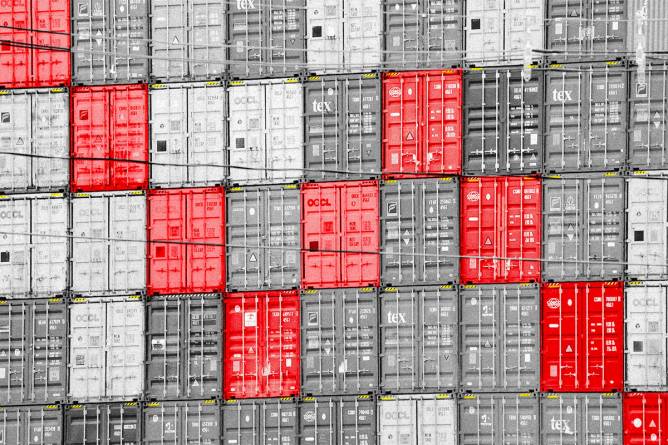
Any hopes that the International Longshoremen’s Association and port operators could work things out were dashed today as about 25,000 dockworkers on the East and Gulf coasts walked off the job.
Workers have argued for higher pay and protections against automation, points the two parties weren’t able to agree on before on the expiration of the dockworkers’ contract on September 30.
The shutdown could cost the economy between $3.8 billion and $4.5 billion a day, according to JP Morgan analyst Brian Ossenbeck.
In other words: The first dockworker strike since 1977 is going to hit the economy like a tidal wave.
Will your portfolio be thrown overboard?
With billions in economic damages piling up by the day, investors will feel some pain. But many of the industries that will be hit the hardest, like retail and manufacturing, have been anticipating the strike and shoring up their inventory in advance, blunting some of its impact. Unfortunately, the longer the strike lasts, the harder this disruption to the supply chains of retailers like Walmart, Costco, and Home Depot will hurt.
The already beleaguered auto industry will take one of the biggest hits, but the damage will mainly be to European carmakers that rely on the affected ports, such as BMW and Volkswagen. According to Barclays analyst Dan Levy, over 70% of auto imports come through the ports shuttered by the strike—but domestic automakers shouldn’t be hurt as badly.
Some companies, on the other hand, are set to get a boost. Air freight providers like FedEx and UPS will benefit directly from the strike, according to Stifel analysts, who reiterated their “buy” rating on the two stocks earlier today.
The impact on railroads is a little less straightforward. “With respect to the rails, there are clearly some near-term headwinds to both East Coast rails (CSX Corp, Buy and Norfolk Southern Corp, Hold),” the Stifel analysts wrote.
Hopefully the labor dispute gets sorted out sooner rather than later and the damage is mitigated to just the short term—which means it could present a buying opportunity, if you’re willing to risk it.—LB
|
|
|
Bottom line: Whether retirement is right around the corner or far off on the horizon, thinking about it is always a good idea. That’s where Betterment comes in.
Whether you’ve never invested a dime or already have an IRA and a 401(k), they can help you sail into retirement with automated tech and expert guidance.
And here’s the cherry on top: Betterment can give your retirement a boost with a 1% IRA match when you open a Roth or traditional IRA and invest up to the annual limit ($7k if you’re under 50, $8k if 50+) before Dec. 30. We’ve got a no-brainer here.
Claim the offer.
|
|
🟢 What’s up
-
Energy was the top-performing sector in the S&P 500 today thanks to rising fears of fighting between Iran and Israel. APA Corp. rose 4.91%, Halliburton climbed 3.10%, and Occidental Petroleum gained 3.33%.
-
Defense stocks rose for much the same reason, with Lockheed Martin up 3.66%, Northrop Grumman trading 3.04% higher, and L3Harris Technologies up 3.03%
-
Hess Corp. and Chevron rose after the FTC declared that, as long as John Hess isn’t allowed to sit on the board, the two companies might be allowed to merge. Shares of Hess gained 2.34%, while Chevron climbed 1.68%.
-
New Fortress Energy popped 6.49% on the news that it has priced a public offering of 46 million shares at $8.46 per share. That will go a long way to helping the struggling energy stock rake in some much-needed cash.
-
Arcos Dorados, the world’s biggest McDonald’s franchisee, jumped 14.56% after it renewed its agreement with McDonald’s, locking down a flat royalty rate for the next decade.
 What’s down What’s down
-
Signet Jewelers fell 7.91% on the news that CEO Virginia Drosos, who has led the company to strong success over the past seven years, will retire.
-
HP sank 3.09% after Citi analysts downgraded the company based on lower PC and printer demand in the years ahead.
-
Disney received a rare analyst downgrade today from Raymond James analysts, who think that theme park attendance will continue to slow in the next 12 to 18 months. Shares dropped 2.14%.
-
Amentum Holdings plummeted 20.16% only a day after the engineering services company debuted on the S&P 500.
|
|
“I’ve hesitated to say this at the risk of sounding hyperbolic, but with last week’s big GDP revisions, there is no denying it: This is among the best performing economies in my 35+ years as an economist.”
Chief Economist at Moody’s Analytics Mark Zandi has finally said the quiet part out loud: The economy isn’t so bad. In fact, it’s actually doing pretty great.
In his post on X yesterday, Zandi detailed the myriad ways the economy has surprised to the upside recently: GDP has risen 3% this year, unemployment is a healthy 4%, and inflation is diminishing.
Don’t get us wrong—when the cost of just about everything has risen dramatically over the last few years, it’s tough to feel good about the economy. Zandi notes that lower-income households have been hit particularly hard, and a tight housing market has disproportionately helped homeowners while keeping houses out of reach for many homebuyers.
All that being said, with the Federal Reserve cutting interest rates, there’s still a ton of potential upside ahead for the economy. “There are plenty of threats. But in my time as an economist, the economy has rarely looked better,” Zandi wrote.
|
|
James Marshall/Getty Images
|
New Year's Eve might feel like it just happened, but 2024 is almost over.
When we’re not busy contemplating the passage of time, we’re celebrating what a great year it’s been for stocks, crypto, and commodities.
Investors just experienced the best three quarters of the 21st century for equities. Yes, you read that right. The S&P 500 is up about 21% from the beginning of the year, albeit with some extreme highs and lows this summer.
Here is how the rest of the year is expected to play out, according to analysts and economists.
A soft landing ( ): Analysts are overall bullish for the rest of the year. Some, including those from DataTrek, believe the S&P 500 could reach as high as 6,000 in 2024—over 4% above where shares trade now. And they’re not even the most bullish: BMO raised its year-end price target from 5,600 to 6,100 just last month. ): Analysts are overall bullish for the rest of the year. Some, including those from DataTrek, believe the S&P 500 could reach as high as 6,000 in 2024—over 4% above where shares trade now. And they’re not even the most bullish: BMO raised its year-end price target from 5,600 to 6,100 just last month.
The Fed’s rate cut path: As inflation cools, it looks like Fed Chairman Jerome Powell really did pull a Greenspan. Investors expect the central bank to lower rates by another 50 basis points by the end of the year, but in a few smaller cuts, rather than another major chop. Powell emphasized that the labor market will be a key metric that Fed officials will keep an eye on to finalize their descent.
The election: You may not have heard, but the US is actually in a presidential election year! Even while we’ve all been mercilessly inundated with polling updates, outlandish claims, and at times downright shocking news cycles, election-related volatility shouldn’t last long-term, according to analysts.
Big Tech renaissance: Stocks fueled by AI hype had a rather muted third quarter, after carrying the market on their backs for all of 2023. But DataTrek analysts recently explained that “large cap Tech is showing signs of life after spending most of Q3 in the wilderness.” Heavyweights like Nvidia, Tesla, and Apple are going to report earnings in the next few weeks, and the spotlight will be focused on their AI-related profits.
While we do our best to give you a heads-up about what’s coming, if there’s one thing that’s certain when it comes to politics, the Federal Reserve, and the stock market itself, it's to expect the unexpected.—LB
|
|
Your retired self will thank you. PSA for aspiring retirees: Betterment is offering a 1% IRA match when you open a Roth or traditional IRA and invest up to the annual limit ($7k if you’re under 50, $8k if you’re 50+). Just claim the offer before Dec. 30. Get started. |
|
-
Did you hear that sigh of relief coming from the Federal Reserve? Job openings increased more than expected in August, a sign that the labor market maybe isn’t so bad after all.
-
Want to retire a millionaire? Here’s how much you’ll need to save each month if you start setting money aside at ages 25, 30, 35, or 40.
-
Investors are too optimistic about interest rate cuts, according to BlackRock CEO Larry Fink. Rather than rely on the Fed to prop up their portfolios, Fink says investors should focus on positioning for higher infrastructure spending.
-
How desperate is the US to encourage domestic semiconductor manufacturing? President Biden may allow chipmakers to skirt environmental protection laws.
-
The wild world of real estate just got a major overhaul thanks to new rules for the National Association of Realtors. Here’s what buyers and sellers need to know.
-
You love chicken tenders, we love chicken tenders, AMERICA loves chicken tenders. But have you ever stopped to consider why we all love chicken tenders so much?
|
|
|
Tomorrow brings us yet another report on the labor market. This time it’s the ADP National Employment Report, a deep dive into private employment across the US.
This report hasn’t been pretty recently. The August reading revealed that private employers added just 99,000 jobs that month, which marked the 5th straight monthly slowdown. Don’t get it wrong: There are still more new jobs being added month by month—but with all eyes on the labor market at the moment, the ongoing slowdown is a cause for concern. Economists are hoping to see 128,000 jobs added in September, and anything under that number will be sure to raise eyebrows among central bankers.
 Before the open Before the open
-
Tilray Brands (TLRY) has struggled this year as marijuana legalization slows down across the US and new avenues of growth fail to materialize. In the past, the marijuana grower has utilized its cash reserves to acquire competitors in order to foster growth—but that strategy is running out of steam, just like the company is running out of money. A recent pivot into craft beer seems more desperate than inspired, and won’t do much to bolster this struggling stock’s bottom line anytime soon. Consensus: -$0.04 EPS, $218.24 million in revenue.
 After the close After the close
-
NovaGold Resources (NG) has all of its eggs in one basket. Of course, when that basket is gold, and gold is having a record-breaking year, it’s not such a bad thing. The miner has operated the Donlin Gold Mine in Alaska alongside Barrick Gold for over a decade now, producing over a million ounces of gold per year. The high expense of operating the mine means margins are slim and earnings are negative, but when gold has its best Q3 since 2020, who cares about the bottom line? Consensus: -$0.02 EPS, no realized revenues.
|
|
ADVERTISE
//
CAREERS
//
SHOP
//
FAQ
Update your email preferences or unsubscribe
.
View our privacy policy
.
Copyright ©
2024
Morning Brew. All rights reserved.
22 W 19th St, 4th Floor, New York, NY 10011
|
|